

⭐ Jack Botanicals - America's #1 Kratom Brand
AKA Approved | Best Quality & Prices Guaranteed
🎉 EXCLUSIVE: Use Code JACK30 for 30% OFF
Claim Your Discount Now →Kratom is legal at the federal level in the United States but banned in six states and several countries. Growing kratom at home is legal in most US states where kratom itself is permitted, but commercial cultivation faces additional regulatory hurdles. The legal landscape shifts frequently, so checking your specific state and local laws before purchasing or growing is essential.
What Is Kratom and Where Does It Come From
Kratom (Mitragyna speciosa) is a tropical tree native to Southeast Asia, primarily Indonesia, Malaysia, Thailand, and Papua New Guinea. Its leaves contain alkaloids, mainly mitragynine and 7-hydroxymitragynine, which interact with opioid receptors in the brain.
- Traditionally used by laborers in Southeast Asia for energy and pain relief
- Leaves are dried and ground into powder, pressed into capsules, or brewed as tea
- Alkaloid content varies by strain, region, and harvest time (mitragynine typically ranges from 0.5% to 1.5% of dry leaf weight)
- Common forms sold in the US: kratom powder, capsules, extracts, and drinks
The data confirms that most kratom sold in the US originates from Indonesia, where it is grown on large farms and exported. Understanding origin matters because import regulations and FDA scrutiny apply at the border level, separate from state laws.
🌿 #1 Kratom Brand - AKA Approved
Premium Quality Kratom at Unbeatable Prices
💥 Use Code: JACK30 - Save 30% OFF!
Shop Jack Botanicals Now →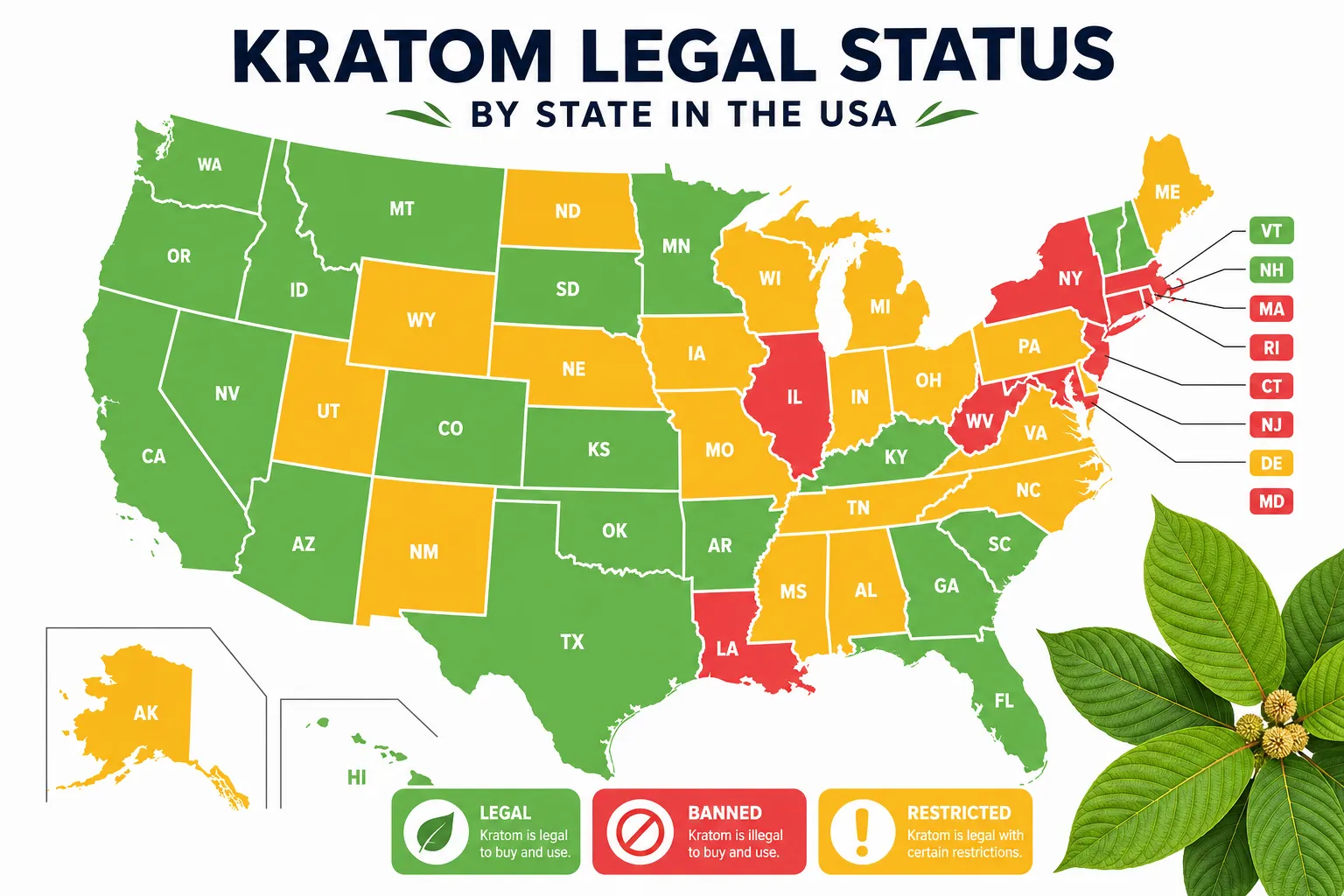
Is Kratom Legal in the United States
Kratom is federally legal in the United States as of 2026. The DEA considered scheduling it as a Schedule I substance in 2016 but reversed course after significant public pushback. It remains unscheduled at the federal level.
What federal legal status means in practice:
- No federal law prohibits possession, purchase, or personal use
- The FDA can and does block kratom imports and issue warning letters to vendors making health claims
- The FTC regulates marketing claims
- State and local laws override federal permissiveness, so federal legality does not protect you in a banned state
For a detailed breakdown of federal rules, see is kratom federally legal in the US.
Common mistake: Assuming federal legality means kratom is legal everywhere in the US. It does not. State law controls.
Kratom Legal Status by State in 2026
Six states currently ban kratom. The remaining 44 states permit it, though several have city or county-level bans within them.
| Status | States |
|---|---|
| Fully banned | Alabama, Arkansas, Indiana, Rhode Island, Vermont, Wisconsin |
| Legal with KCPA regulations | Arizona, Colorado, Georgia, Nevada, Oklahoma, Oregon, Texas, Utah, Virginia |
| Legal, no specific kratom law | Most remaining states |
| Partial bans (city/county) | California (San Diego), Illinois (Jerseyville), New Hampshire (Franklin) |
State-specific resources:
- Is kratom legal in Florida, legal statewide with age restrictions
- Is kratom legal in California, legal statewide, San Diego banned it
- Is kratom legal in Texas, legal, no state-level ban
- Is kratom legal in Georgia, legal with KCPA protections
- Is kratom legal in Ohio, legal statewide
Practical takeaway: Check both state law and your specific city or county before buying or growing.
Can You Grow Kratom at Home Legally
In states where kratom is legal, growing a Mitragyna speciosa plant at home for personal use is generally permitted. No US state has a specific law banning the cultivation of the plant itself, separate from laws banning the substance.
Step by step legal check for home growing:
- Confirm kratom is legal in your state (see the banned states list above)
- Check local ordinances, as some cities ban all kratom-related activity
- Confirm you are growing for personal use, not commercial sale
- Do not attempt to sell or distribute homegrown kratom without a business license and compliance with state KCPA rules where applicable
This matters because kratom plants are sold legally as ornamental plants in many states. The legal issue arises when the leaves are processed and sold as a consumable product. Commercial cultivation for sale requires compliance with state KCPA regulations, FDA labeling rules, and in some cases, agricultural permits.
Kratom Banned Countries List
Kratom is illegal in a significant number of countries. The data confirms that Southeast Asian nations have the strictest historical bans, though Thailand partially reversed its ban in 2021 for medicinal use.
Countries where kratom is banned or heavily restricted:
- Australia (Schedule 9 prohibited substance)
- Malaysia (Poisons Act, though enforcement has varied)
- Thailand (historically banned; 2021 reform allows medicinal use)
- Denmark, Finland, Latvia, Lithuania, Poland, Romania, Sweden (EU bans)
- Japan, South Korea, Singapore
- United Kingdom (Psychoactive Substances Act 2016)
Clear signal: If you are traveling internationally, do not carry kratom. Penalties in some countries include imprisonment.
Why Is Kratom Illegal in Some Places
The core reason is regulatory uncertainty combined with concerns about dependence potential and limited clinical trial data. The FDA classifies kratom as a “botanical with opioid properties,” which triggers scrutiny under existing drug safety frameworks.
Specific reasons jurisdictions have banned kratom:
- Alkaloid profile overlaps with opioid receptor activity, raising addiction concerns
- Limited large-scale human clinical trials as of 2026
- Contamination incidents (heavy metals, salmonella) in unregulated products have prompted state action
- Lobbying by pharmaceutical interests and some public health agencies
- Misclassification in early DEA assessments that some states adopted without independent review
The structure shows a pattern: states that banned kratom early (pre-2018) did so largely on DEA scheduling proposals. States adopting the KCPA since 2019 have moved toward regulation rather than prohibition.
Is Kratom FDA Approved
No. The FDA has not approved kratom for any medical use. It cannot be legally marketed or sold as a drug, dietary supplement with health claims, or food additive in the United States.
What this means for buyers:
- Vendors cannot legally claim kratom treats, cures, or prevents any condition
- Kratom is sold as a botanical or “not for human consumption” in some markets to avoid FDA enforcement
- The FDA has issued import alerts blocking kratom shipments and warning letters to vendors making unapproved health claims
- FDA approval would require clinical trials costing hundreds of millions of dollars, which no kratom company has funded
Practical takeaway: Buy from vendors who make no medical claims and provide third-party lab testing for alkaloid content and contaminants.
Kratom Possession Penalties and Legal Consequences
In states where kratom is banned, possession penalties vary significantly. The data confirms that most banned states treat kratom possession similarly to controlled substance possession.
| State | Penalty Type | Severity |
|---|---|---|
| Alabama | Criminal possession | Misdemeanor to felony |
| Arkansas | Schedule I analog | Felony possible |
| Indiana | Schedule I | Felony |
| Rhode Island | Schedule I | Criminal charge |
| Vermont | Regulated substance | Civil/criminal |
| Wisconsin | Schedule I analog | Felony possible |
In countries like Singapore and Malaysia, penalties can include years of imprisonment. This is not a minor risk.
Common mistake: Ordering kratom online and having it shipped to a banned state. Packages are intercepted and can result in charges.
How Much Does Kratom Cost and Where to Buy It
Kratom powder typically costs $10 to $20 per ounce from reputable online vendors, dropping to $60 to $120 per kilogram when buying in bulk. Capsules run $15 to $30 per ounce equivalent due to processing costs.
Price benchmarks (2026 estimates):
- Powder, 1 oz: $10 to $20
- Powder, 1 kg: $60 to $120
- Capsules, 60-count: $15 to $25
- Extract products: $20 to $50 per small bottle
For a full cost breakdown, see how much does kratom cost.
What to prioritize when buying: AKA (American Kratom Association) accreditation, third-party lab certificates of analysis (COAs), and clear labeling of mitragynine percentage. What to skip: vendors with no COAs, those making health claims, and gas station kratom with no lab data.
To find legal vendors in your area, see where to buy kratom near me.
Kratom vs Other Herbal Supplements: Legal Differences
Most herbal supplements (echinacea, valerian, St. John’s Wort) fall under the Dietary Supplement Health and Education Act (DSHEA) of 1994, which gives them a relatively clear legal pathway. Kratom does not have this protection.
Key legal differences:
- DSHEA supplements can be sold with structure/function claims; kratom cannot
- The FDA has specifically stated kratom does not qualify as a dietary supplement under DSHEA
- Other botanicals face no state-level bans; kratom faces six
- Kratom’s opioid receptor activity places it in a unique regulatory category not shared by most herbal products
This matters because vendors who market kratom as a dietary supplement are operating in a legally gray area that exposes them and buyers to enforcement risk.
How to Check If Kratom Is Legal Where You Live
Start here: use a three-step verification process before purchasing or growing.
Step by step:
- Check your state’s controlled substances list (search “[your state] controlled substances schedule”)
- Check your county or city municipal code (search “[your city] kratom ordinance”)
- Verify with the complete state-by-state kratom legal guide for current status
- If traveling, check the destination country’s customs and narcotics laws
Proven pattern: Laws change faster at the city level than the state level. A state can be legal while a specific city bans it. Always check both layers.
Is Kratom Legal for Personal Use vs Commercial Sale
Personal use and commercial sale face different legal standards. Personal possession in a legal state carries no penalty. Commercial sale requires compliance with multiple regulatory layers.
Commercial sale requirements in KCPA states:
- Age verification (18 or 21 depending on state)
- Product labeling with alkaloid content and batch information
- Third-party testing for contaminants
- No health or drug claims in marketing
- Business licensing as required by state commerce laws
For buying kratom in Massachusetts or other regulated states, vendors must follow specific labeling and age-verification rules. Personal use buyers are not subject to these rules but must still comply with possession laws.
Kratom Legality Changing Soon: Regulations to Watch in 2026
The legal landscape for kratom is actively shifting. Several states are considering KCPA adoption, and federal regulatory proposals resurface periodically.
What to watch in 2026:
- Federal KCPA legislation has been introduced in Congress and would create a national regulatory framework
- States currently evaluating KCPA adoption include several in the Northeast and Midwest
- The FDA’s ongoing review of kratom’s safety profile could trigger new import restrictions
- The AKA continues lobbying efforts to prevent new state bans and promote KCPA as a regulatory alternative
The data confirms that states adopting the KCPA tend to see improved product quality and fewer contamination incidents, which strengthens the argument for regulation over prohibition.
Kratom Legality Checker, US States
Kratom Legal Alternatives If Banned in Your Area
If kratom is banned where you live, several legal botanical alternatives exist. None replicate kratom’s alkaloid profile exactly, but some users report similar effects from specific plants.
Common legal alternatives:
- Kava (Piper methysticum): Legal in all US states, mild anxiolytic effects
- Akuamma seeds (Picralima nitida): Legal in most jurisdictions, contains alkaloids with some opioid receptor affinity
- Blue lotus (Nymphaea caerulea): Legal in most US states, mild sedative
- Corydalis: Legal herbal supplement with pain-modulating properties
Practical takeaway: None of these alternatives are FDA-approved either, and none have the same evidence base as kratom’s more studied alkaloids. Research each one independently before use.
Frequently Asked Questions
Is the kratom plant itself illegal, or just the powder?
Where kratom is prohibited, restrictions can apply to the plant as well as products made from it. However, laws differ by jurisdiction, so check the current state or local rules covering Mitragyna speciosa, raw leaf, powder, and other derivatives.
Can I order kratom online and ship it to my state?
Online kratom purchases are subject to the laws of the destination state and locality. Vendors may also restrict shipments to certain jurisdictions. Always confirm current local requirements before placing an order or transporting kratom.
What is the legal age to buy kratom?
The minimum age varies by jurisdiction. Many states that regulate kratom set an age requirement, commonly 18 or 21, while some local laws may impose different restrictions. See how old do you have to be to buy kratom for more information.
Does the DEA consider kratom a controlled substance?
Kratom is not currently listed as a federally scheduled controlled substance in the United States. The DEA announced in 2016 that it would not proceed with its proposed emergency scheduling of mitragynine and 7-hydroxymitragynine. State and local laws can still restrict kratom.
Is kratom legal in Texas?
Kratom is not subject to a statewide prohibition in Texas, but local rules and regulations can differ. Consumers should verify the current law that applies to their specific city or county. For more information, see is kratom legal in Texas.
Can kratom get you in trouble at work?
Workplace policies can restrict kratom use even where it is legal to possess. Standard drug panels generally do not routinely screen for kratom, although specialized testing can detect kratom alkaloids. Review your employer’s current policy and see how long does kratom stay in your urine.
Is kratom legal in Florida?
Kratom is not subject to a statewide ban in Florida, but state and local regulations can change. Consumers should check current Florida requirements and any applicable local rules before purchasing or possessing kratom. See is kratom legal in Florida for additional information.
What happens if I’m caught with kratom in a banned state?
Consequences depend on the jurisdiction, the applicable law, the amount involved, and the circumstances. Potential consequences can include confiscation, fines, or criminal charges. Because laws vary considerably, check the current statute or consult a qualified local attorney.
Is kratom regulated differently for extracts vs powder?
Some laws apply broadly to kratom regardless of whether it is sold as powder, capsules, extracts, or raw leaf, while other jurisdictions may impose product-specific requirements. Extract products can also be subject to additional labeling or composition rules.
Can I grow kratom commercially in the US?
Commercial kratom cultivation involves more than simply growing the plant. Businesses must comply with applicable state and local laws, agricultural requirements, business regulations, and rules governing the processing and sale of kratom products. Requirements vary by jurisdiction.
Conclusion
The answer to “is the kratom plant legal” depends entirely on location. Start with your state, then check your city or county, then verify if you are traveling internationally.
Actionable next steps:
- Use the legality checker above or the full state-by-state guide to confirm your status
- If legal in your state, buy only from AKA-accredited vendors with third-party COAs
- If growing at home, confirm personal-use intent and check local ordinances
- Monitor 2026 legislative sessions in your state, as KCPA adoption and new bans are both active possibilities
- Never ship kratom to a banned state, even as a gift
The structure shows that regulation, not prohibition, is the direction most states are moving. Staying informed is the lowest-risk strategy.
References
- American Kratom Association. (2023). Kratom Consumer Protection Act model legislation. https://www.americankratom.org
- US Drug Enforcement Administration. (2016). Withdrawal of notice of intent to temporarily place mitragynine and 7-hydroxymitragynine into Schedule I. Federal Register.
- US Food and Drug Administration. (2019). Statement from FDA Commissioner Scott Gottlieb on FDA’s scientific evidence on the presence of opioid compounds in kratom. https://www.fda.gov
- Eastlack, S. C., Cornett, E. M., & Kaye, A. D. (2020). Kratom, Pharmacology, clinical implications, and outlook: A comprehensive review. Pain and Therapy, 9(1), 55-69.
- Henningfield, J. E., et al. (2019). Kratom abuse potential 2019: An updated eight factor analysis. Preventive Medicine, 128, 105785.
- Thailand Narcotics Control Board. (2021). Amendment to the Narcotics Act: Removal of kratom from Schedule 5. Bangkok: ONCB.
Eric Larson is a researcher and writer passionate about ethnobotany and traditional plant knowledge. With a background in anthropology and sustainable agriculture, he explores how indigenous communities have used natural remedies for generations. Eric believes in bridging the gap between ancestral wisdom and modern science through clear, honest storytelling. His work focuses on documenting plant-based traditions while emphasizing safety, sustainability, and cultural respect. When not writing, Eric volunteers with botanical conservation projects and enjoys hiking in search of medicinal plants in their natural habitats.
Nathaniel is deeply interested in cultural traditions and the way natural elements shape human expression. He has studied how communities integrate plants into their daily rituals, folklore, and heritage. Nathaniel believes these practices hold timeless lessons about respect for nature and the importance of cultural continuity. His work centers on appreciating and preserving these insights with curiosity and authenticity, always highlighting the link between the past and the present.