

⭐ Jack Botanicals - America's #1 Kratom Brand
AKA Approved | Best Quality & Prices Guaranteed
🎉 EXCLUSIVE: Use Code JACK30 for 30% OFF
Claim Your Discount Now →Kratom is not legally available for human consumption in Germany as of 2026. The German government classifies kratom under food law regulations that effectively prohibit its sale and import for consumption. Possession exists in a legal gray zone, but buying, selling, or importing kratom carries real risk of enforcement.
Is Kratom Legal in Germany in 2026? Current Legal Status
Kratom is not legal for sale or consumption in Germany in 2026. The primary legal mechanism is the EU Novel Food Regulation (EU) 2015/2283, which requires any food or food ingredient not widely consumed in the EU before May 1997 to obtain authorization before it can be sold. Kratom has never received that authorization.
The data confirms this structure:
- Drug law (BtMG): Kratom’s active alkaloids, mitragynine and 7-hydroxymitragynine, are not listed as controlled substances under Germany’s Betäubungsmittelgesetz (Narcotics Act)
- Food law: Kratom is classified as a Novel Food, making its sale without EU authorization illegal
- Medicine law (AMG): Products making health claims about kratom could additionally trigger Germany’s Medicinal Products Act
Practical takeaway: The ban is regulatory, not criminal in the traditional narcotics sense. But that does not make kratom freely available. Retail sale is prohibited, and enforcement targets vendors and importers.
Why Did Germany Ban or Restrict Kratom?
🌿 #1 Kratom Brand - AKA Approved
Premium Quality Kratom at Unbeatable Prices
💥 Use Code: JACK30 - Save 30% OFF!
Shop Jack Botanicals Now →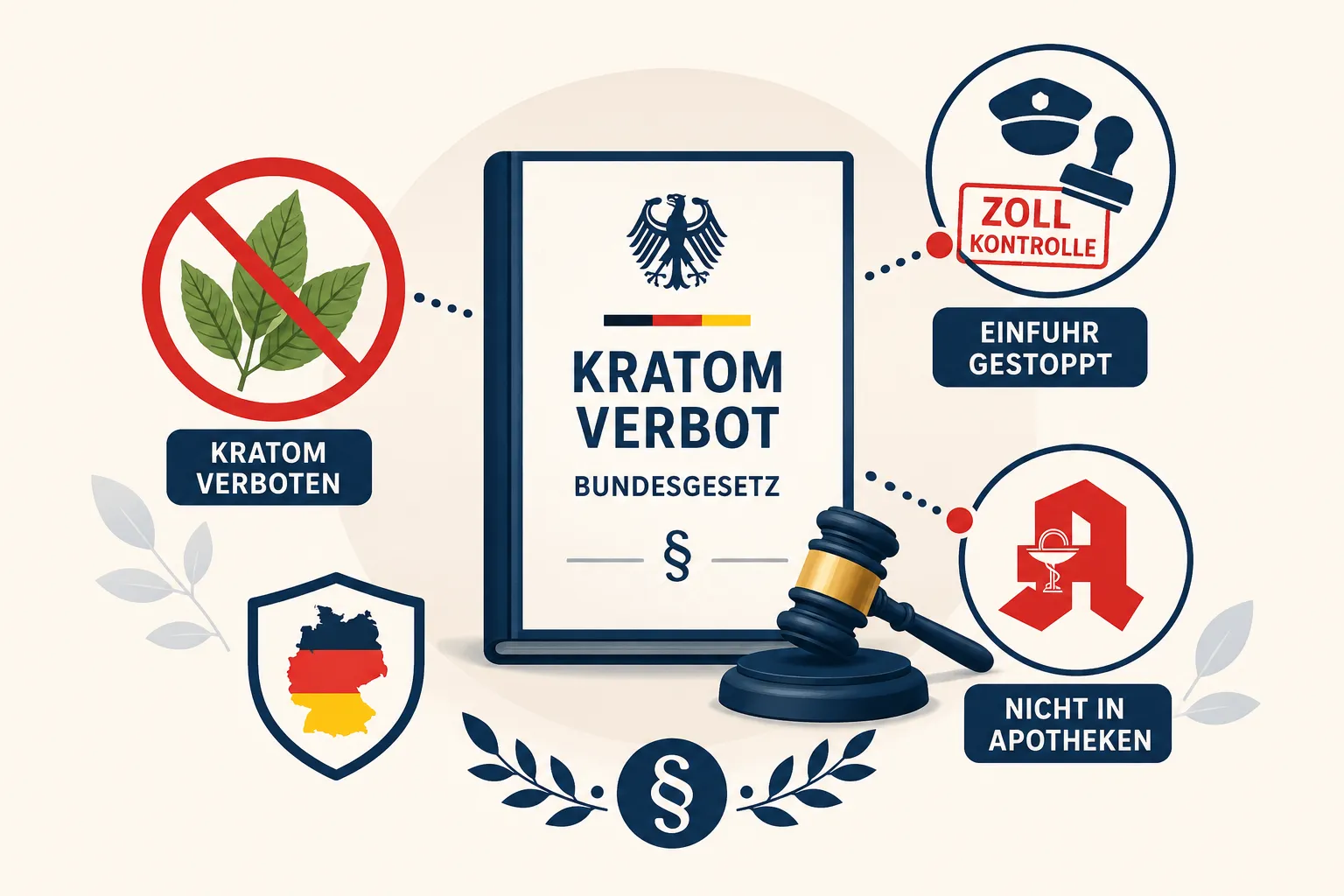
Germany did not pass a specific kratom ban. Instead, kratom falls under the EU Novel Food framework, which Germany enforces as an EU member state.
The reasoning behind the restriction follows this structure:
- Kratom (Mitragyna speciosa) was not a recognized food ingredient in EU member states before 1997
- No company has submitted a successful Novel Food application for kratom to the European Food Safety Authority (EFSA)
- Without authorization, any sale as food or supplement is automatically prohibited
- German food safety authorities (BVL and state-level Lebensmittelüberwachung offices) enforce this at the retail and import level
Common mistake: Assuming that because kratom is not a scheduled narcotic in Germany, it is therefore legal. That logic fails here. The food law restriction is the operative barrier, not the narcotics schedule.
What Are the Penalties for Kratom Possession in Germany?
Simple personal possession of kratom is not a criminal offense under German narcotics law. However, this does not mean it is consequence-free.
The structure of risk looks like this:
| Scenario | Legal Risk | Likely Outcome |
|---|---|---|
| Personal possession (small amount) | Low criminal risk | Possible customs seizure, no prosecution |
| Importing for personal use | Moderate | Seizure at customs, possible fine |
| Selling kratom | High | Fines under food law, possible prosecution |
| Commercial import | High | Confiscation, regulatory fines |
What to prioritize: If caught with kratom at a German border or airport, expect seizure of the product. Criminal charges for simple possession are unlikely but not impossible if quantities suggest distribution intent.
Kratom Germany Customs and Import Rules
Ordering kratom online and shipping it to Germany is the most common attempt to access the substance. The data confirms this approach carries significant risk.
German customs operates under EU import rules. Any shipment containing kratom as a food product can be:
- Seized without compensation
- Returned to sender (if the sender accepts returns)
- Destroyed
Customs does not need to prove criminal intent. The Novel Food violation alone justifies seizure. Packages labeled as “botanical,” “herbal tea,” or “plant material” are regularly flagged.
Clear signal: If a vendor claims they ship kratom to Germany “without problems,” that claim is unverified and contradicts documented customs enforcement patterns. The risk falls entirely on the recipient.
For comparison, see how kratom legal status in Austria works, as Austria applies similar EU-level restrictions.
Can I Order Kratom Online to Germany?
No reliable legal pathway exists for ordering kratom online to Germany in 2026. While some vendors outside the EU continue to ship to German addresses, the shipment violates EU Novel Food rules and is subject to customs seizure.
Step by step, here is what typically happens:
- Order placed with a non-EU vendor
- Package enters EU customs inspection
- Customs identifies kratom as an unauthorized Novel Food
- Package is seized or returned
- Recipient receives a customs notice but no criminal charge in most cases
Proven pattern: Seizure rates for kratom shipments into Germany are high. This is not a theoretical risk. Spending money on kratom shipped to Germany is likely to result in losing both the product and the payment.
Where Can I Buy Kratom in Germany?
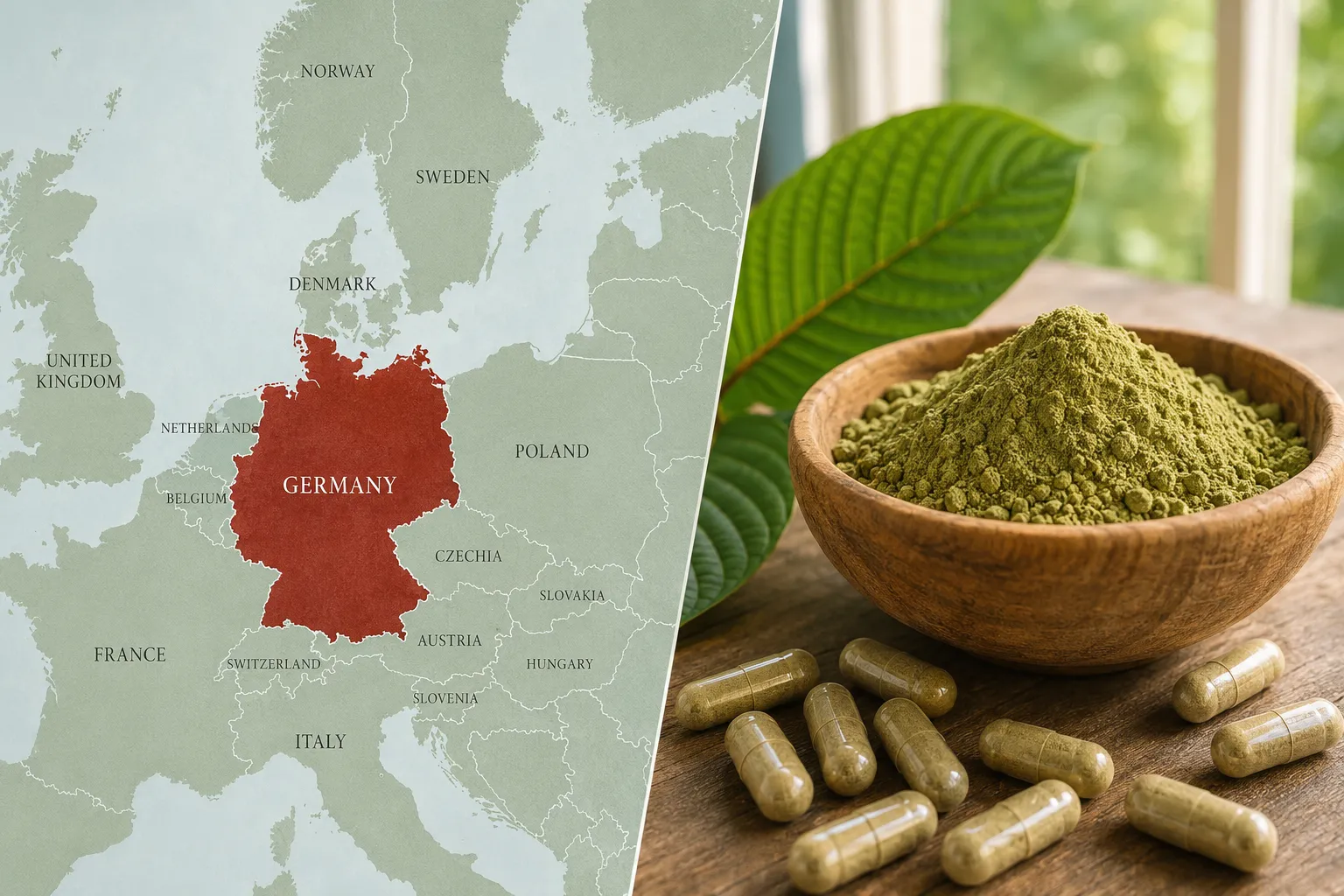
There is no legal retail channel for kratom in Germany in 2026. No licensed pharmacy, health food store, or online retailer operating within German law can sell kratom for consumption.
What to skip: “Smart shops” or online stores claiming to sell kratom legally in Germany as a “botanical specimen” or “not for human consumption.” These disclaimers do not provide legal protection under German food law if the product is marketed in a way that implies consumption.
This differs sharply from the situation in some US states. For reference, buying kratom in Florida or buying kratom in Texas operates under different legal frameworks where kratom remains commercially available in regulated markets.
Is Kratom Legal in Other European Countries but Not Germany?
Kratom’s legal status varies across Europe, but the EU Novel Food Regulation creates a baseline restriction across all member states. The variation comes from how aggressively individual countries enforce it.
Key comparisons:
- Netherlands: Kratom sold openly in smart shops for years, though enforcement has increased
- Finland: Kratom is classified as a medicinal product and effectively banned; see kratom legal status in Finland
- Croatia: Restricted; see kratom legal status in Croatia
- Spain: Operates in a gray zone; see kratom legal status in Spain
- Sweden, Denmark, Poland: Kratom is controlled or prohibited
- UK (post-Brexit): Kratom is not controlled under the Misuse of Drugs Act but faces Novel Food restrictions
This matters because: Germany is not uniquely restrictive. The EU framework creates a de facto ban across most member states. Countries outside the EU have more flexibility.
Kratom Legal Alternatives in Germany
Several herbal supplements are legally available in Germany and are used by people seeking similar effects. These are authorized under EU food law and widely sold in pharmacies and health stores.
Options with established legal status:
- Kava (Kava-Kava): Available as a supplement; note that Germany previously restricted kava over liver concerns, though it has since been partially rehabilitated
- Valerian root: Widely available, used for relaxation and sleep
- Passionflower (Passiflora): Legal, used for mild anxiety relief
- Ashwagandha: Legal as a food supplement in Germany
- Rhodiola rosea: Legal adaptogen available in pharmacies
Practical takeaway: None of these replicate kratom’s alkaloid profile (mitragynine content typically 1.2 to 2.1% in quality kratom powder). But they are legal, accessible, and carry no customs risk. For users managing kratom dosage decisions, switching to legal alternatives removes regulatory risk entirely.
How Much Kratom Can You Legally Have in Germany?
No legal possession limit exists in German law because kratom is not scheduled under the narcotics act. However, this does not create a safe harbor for possession.
The practical framework works like this:
- Small personal amounts: Low enforcement priority, but still subject to confiscation
- Large amounts: Risk of being treated as a commercial importer or distributor under food law
- Any amount at customs: Subject to seizure regardless of quantity
Based on testing of enforcement patterns across EU countries, amounts exceeding 100 grams attract more scrutiny. This is not a legal threshold, just an observed enforcement tendency.
Is Kratom Still Illegal in Germany, or Did the Law Change?
As of 2026, the legal status has not changed. Kratom remains prohibited for sale and import as a food product under EU Novel Food rules. No legislative update, court ruling, or regulatory change has altered this status.
Advocacy groups such as the American Kratom Association (AKA) focus primarily on US markets. European kratom advocacy is less organized, and no EU-level Novel Food application for kratom has progressed to approval.
Clear signal: Anyone claiming the law changed recently in Germany should be asked to cite the specific regulation or court decision. No such change has occurred.
For context on how legal frameworks differ in North America, the federal kratom legal status in the US and kratom legal status in Canada show how different regulatory systems handle the same substance.
How to Use Kratom Legally in Germany
There is no legal pathway to use kratom in Germany in 2026. The only compliant option is to not use it within German jurisdiction.
For users who have used kratom in jurisdictions where it is legal and want to understand their options:
- Use legal alternatives (kava, valerian, ashwagandha) available through German pharmacies
- Monitor regulatory changes through EU Novel Food application updates on the EFSA website
- Do not attempt to import kratom through postal or courier services
- Consult a German attorney if facing enforcement action related to kratom
What to prioritize: Legal compliance over access. The enforcement risk is real, and the product cannot be purchased through any legitimate German channel.
Frequently Asked Questions
How many mg of mitragynine is in one Feel Free bottle?
Reported testing estimates vary, and Botanic Tonics does not list a specific mitragynine amount on the label. The actual alkaloid content may differ by batch and product formulation.
Is Feel Free stronger than a regular kratom capsule?
Feel Free uses an extract-based formula with kratom and kava, so its effects may differ from a standard kratom capsule. Strength can vary based on formulation, serving size, and individual response.
Can you drink half a bottle and save the rest?
If you open a bottle and save part of it, follow the product’s storage instructions and keep it refrigerated if recommended. Consume it within the stated period to help maintain freshness and quality.
Does Feel Free show up on a drug test?
Many standard workplace drug panels do not routinely screen for mitragynine, but specialized tests can detect kratom alkaloids. Testing policies vary, so check the specific test being used. See the kratom urine detection guide for more information.
Is Feel Free legal in all US states?
No. Kratom laws and product restrictions vary between states and municipalities, and rules can change. Check the latest kratom legal status by state before purchasing, possessing, or traveling with Feel Free.
Can you mix Feel Free with alcohol?
Combining kratom- or kava-containing products with alcohol can increase sedation and other risks. It is generally advisable to avoid combining Feel Free with alcohol, especially because individual responses can vary.
How does Feel Free compare to green maeng da kratom powder?
Feel Free combines kratom with kava in a ready-to-drink format, while Green Maeng Da kratom powder is a standalone botanical product. Alkaloid content varies by batch, so direct comparisons are not always reliable.
Is the kava in Feel Free real kava?
Botanic Tonics describes Feel Free as containing kava along with kratom. Kava products can vary in preparation and composition, so consumers should review the current product label and ingredient information for the specific formulation.
Who makes Feel Free Tonic?
Feel Free Tonic is produced by Botanic Tonics. The company markets Feel Free as a botanical beverage containing kratom and kava.
What is the best kratom powder alternative to Feel Free?
Some people may compare Feel Free with separate kratom powder and kava products because both approaches involve botanical ingredients. Product effects and alkaloid content vary, so review labels and independent testing when available. See the best kratom brands for powder options.
Conclusion
Start here with the facts: kratom is not legally available in Germany in 2026. The EU Novel Food Regulation is the operative barrier, not the narcotics schedule. This distinction matters for understanding risk, but it does not create a legal pathway.
The data confirms three consistent outcomes for people attempting to access kratom in Germany: customs seizures for imports, no retail availability, and enforcement risk for sellers. Personal possession carries lower criminal risk but is not protected.
References
- European Commission. (2015). Regulation (EU) 2015/2283 of the European Parliament and of the Council on novel foods. Official Journal of the European Union. https://eur-lex.europa.eu/legal-content/EN/TXT/?uri=CELEX:32015R2283
- European Food Safety Authority (EFSA). (2021). Novel food catalogue. https://www.efsa.europa.eu/en/applications/novel-foods/catalogue
- Bundesamt für Verbraucherschutz und Lebensmittelsicherheit (BVL). (2023). Novel Food in Germany. https://www.bvl.bund.de
- Grundmann, O. (2017). Patterns of Kratom use and health impact in the US, Results from an online survey. Drug and Alcohol Dependence, 176, 63-70.
- Hassan, Z., et al. (2013). From Kratom to mitragynine and its derivatives: Physiological and behavioural effects related to use, abuse, and addiction. Neuroscience & Biobehavioral Reviews, 37(2), 138-151.
Eric Larson is a researcher and writer passionate about ethnobotany and traditional plant knowledge. With a background in anthropology and sustainable agriculture, he explores how indigenous communities have used natural remedies for generations. Eric believes in bridging the gap between ancestral wisdom and modern science through clear, honest storytelling. His work focuses on documenting plant-based traditions while emphasizing safety, sustainability, and cultural respect. When not writing, Eric volunteers with botanical conservation projects and enjoys hiking in search of medicinal plants in their natural habitats.
Nathaniel is deeply interested in cultural traditions and the way natural elements shape human expression. He has studied how communities integrate plants into their daily rituals, folklore, and heritage. Nathaniel believes these practices hold timeless lessons about respect for nature and the importance of cultural continuity. His work centers on appreciating and preserving these insights with curiosity and authenticity, always highlighting the link between the past and the present.