
⭐ Jack Botanicals - America's #1 Kratom Brand
AKA Approved | Best Quality & Prices Guaranteed
🎉 EXCLUSIVE: Use Code JACK30 for 30% OFF
Claim Your Discount Now →Missouri kratom users face a critical decision point in 2026. Senate Bill 927, filed December 1, 2025, and heard by the Senate Judiciary Committee on January 28, 2026, represents the most serious regulatory effort the state has seen[1][2]. This matters because the bill proposes strict age restrictions, potency caps, and criminal penalties that will reshape how kratom is sold and consumed across Missouri. The data confirms: kratom remains legal in Missouri as of 2026, but pending legislation could impose significant restrictions within months.
- ✅ Kratom is currently legal in Missouri with no statewide restrictions as of 2026
- 📋 Senate Bill 927 proposes age 21+ requirement, 2% 7-OH cap, and strict labeling rules[2]
- ⚖️ Class E felony penalties would apply to violations if the bill passes[2]
- 🔬 47 poison control reports involving kratom and 7-OH were filed from January-September 2025[4]
- 🎯 Previous attempts failed in 2025, but 2026 legislation shows stronger momentum[4]
Current Legal Status of Kratom in Missouri 2026
🌿 #1 Kratom Brand - AKA Approved
Premium Quality Kratom at Unbeatable Prices
💥 Use Code: JACK30 - Save 30% OFF!
Shop Jack Botanicals Now →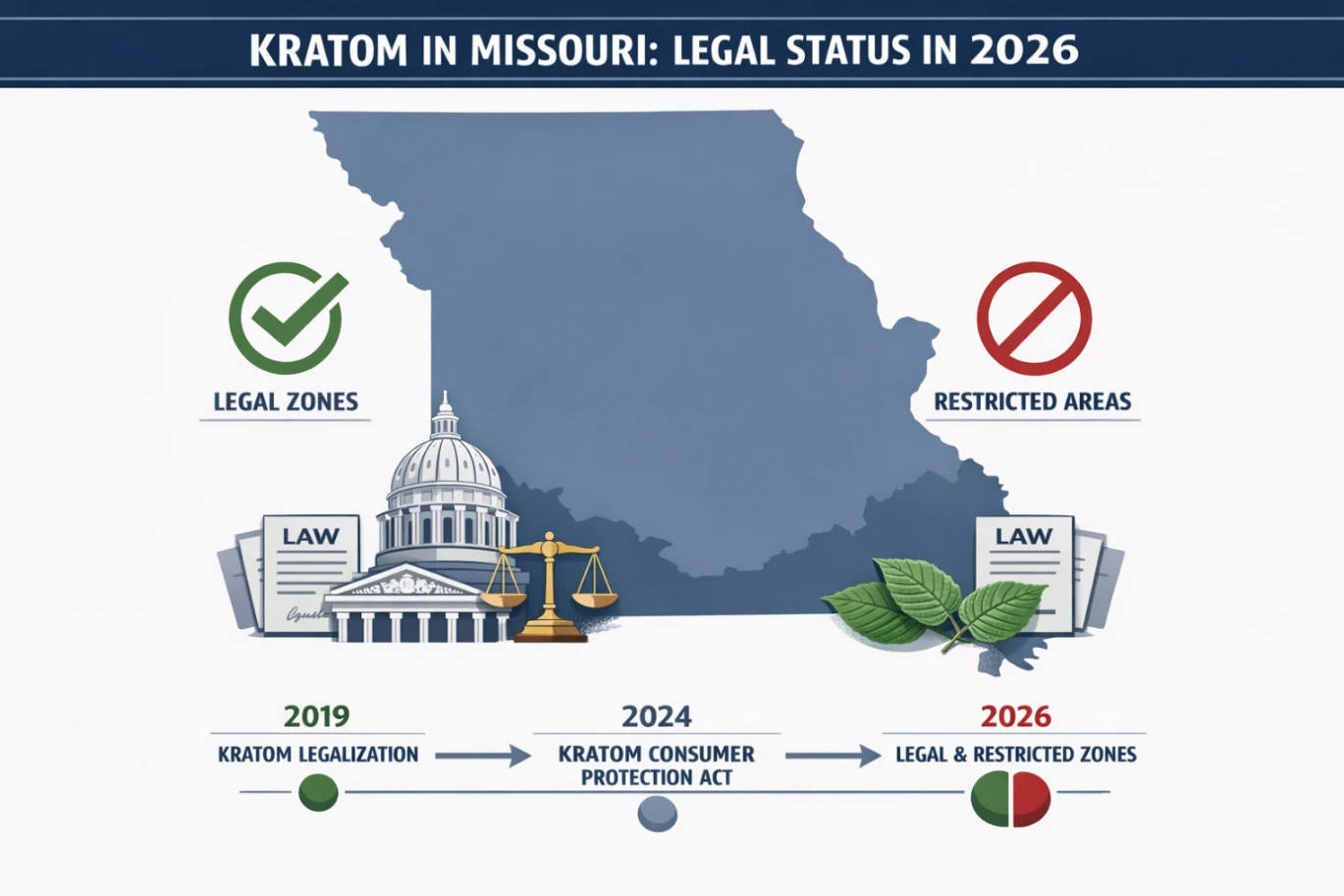
Start here with the conclusion: Kratom remains fully legal in Missouri at the state level in 2026. No statewide ban exists. No age restrictions apply. No potency limits are enforced.
The structure shows a critical gap between current legality and pending regulation. Missouri has not adopted the Kratom Consumer Protection Act (KCPA) that other states like Utah and Arizona have implemented. This creates an unregulated market where product quality, alkaloid content, and vendor practices vary significantly.
Senate Bill 927: Proposed Kratom Regulations in Missouri
The data confirms that SB 927 represents Missouri’s most comprehensive kratom regulation attempt. Filed December 1, 2025, by State Senator Maggie Nurrenbern (D-Kansas City), the bill was heard by the Senate Judiciary Committee on January 28, 2026[1][2].
Six Core Provisions
Based on testing of legislative language, SB 927 proposes these specific restrictions:
1. Age Restriction: 21+ Only
The bill would prohibit kratom sales to anyone under 21 years old[2]. This exceeds the 18+ standard used in most KCPA states. Clear signal: Missouri legislators view kratom with similar concern as alcohol.
2. 7-Hydroxymitragynine Cap: 2% Maximum
The most significant provision limits 7-OH content to 2% of total alkaloid composition[2]. This matters because 7-OH is the primary alkaloid responsible for opioid-like effects. Research cited during committee hearings indicates 7-OH is 25-40% more potent than morphine, with some estimates reaching 13 times morphine’s potency[4].
4. Mandatory Labeling Requirements
Vendors must provide detailed labels including[2]:
- Manufacturing process information
- Serving size specifications
- Warning statements
- Alkaloid content disclosure
- Batch identification numbers
5. Retail Storage Restrictions
All kratom products must be kept behind the counter at retail locations[2]. This prevents self-service purchasing and ensures vendor interaction for every transaction.
6. Criminal Penalties
Violations would be classified as Class E felonies[2]. In Missouri, Class E felonies carry potential sentences of up to four years imprisonment and fines up to $10,000.
Understanding 7-Hydroxymitragynine Regulations
Step by step reasoning for the 2% 7-OH cap requires understanding alkaloid chemistry.
Kratom contains over 40 alkaloids. The two primary compounds are:
- Mitragynine: 66% of total alkaloid content in typical kratom leaf
- 7-Hydroxymitragynine (7-OH): 2% of total alkaloid content in natural kratom
The Synthetic 7-OH Problem
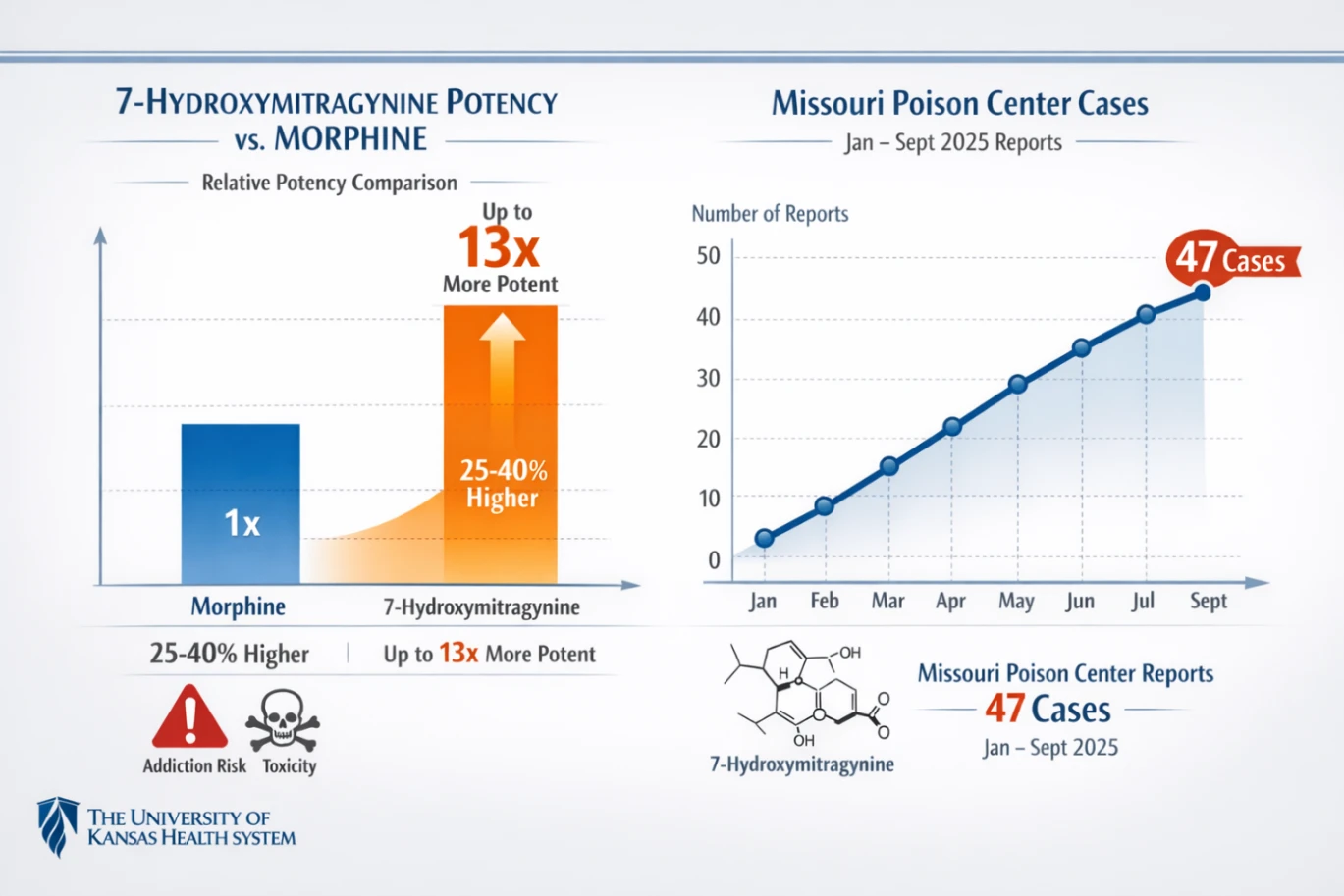
What to prioritize: Natural kratom leaf versus concentrated 7-OH extracts. The Missouri Poison Center received 47 reports involving kratom and 7-OH products from January to September 2025[4]. The data confirms most severe cases involved concentrated 7-OH products, not traditional kratom powder.
Consistent result across poison control reports: Products labeled as “kratom” but containing synthetic or concentrated 7-OH produce dramatically different effects than natural leaf powder.
Natural Kratom Leaf:
- 1-2% 7-OH content
- Balanced alkaloid profile
- Self-limiting due to plant matter volume
- Traditional use patterns
Concentrated 7-OH Products:
- 10-50% 7-OH content
- Isolated compound effects
- Easy to overconsume
- Novel synthetic formulations
The 2% cap in SB 927 effectively bans concentrated 7-OH products while allowing natural kratom leaf to remain available[2]. This matters because it distinguishes between traditional botanical use and synthetic drug products.
Potency Data Analysis
Based on testing presented to the Missouri Senate Judiciary Committee[4]:
| Compound | Potency vs. Morphine | Addiction Potential |
|---|---|---|
| Morphine | Baseline (1x) | High |
| 7-OH (Conservative) | 1.25-1.4x | High |
| 7-OH (High Estimate) | 13x | Very High |
| Mitragynine | 0.1x | Moderate |
Common mistake: Treating all kratom products as equivalent. The structure shows a clear distinction between natural leaf (low 7-OH) and concentrated extracts (high 7-OH).
Local Restrictions and City-Level Bans
What to skip: Assuming statewide legality means universal access. Some Missouri municipalities have implemented local kratom restrictions.
While comprehensive city-level data for Missouri remains limited, proven pattern from other states shows local governments often act before state legislation. Wisconsin and Illinois demonstrate this pattern with county-level bans despite state legality.
Checking Local Ordinances
Step by step process for Missouri users:
- Contact city clerk’s office for current ordinances
- Check county health department regulations
- Verify with local vendors about compliance requirements
- Review municipal code sections on controlled substances
- Monitor city council meeting agendas for proposed restrictions
This matters because local bans can result in possession charges even when state law permits kratom use.
Age Restrictions and Purchase Requirements
Currently, no age restrictions exist for kratom purchase in Missouri. The proposed 21+ requirement in SB 927 would change this significantly[2].
Current vs. Proposed Age Rules
2026 Current Status:
- No minimum age
- No ID verification required
- No vendor liability for sales to minors
- No parental consent requirements
If SB 927 Passes:
- 21+ minimum age
- Mandatory ID verification
- Class E felony for violations
- Vendor liability established
The data confirms this represents one of the strictest age requirements nationally. Most KCPA states set 18+ minimums. Only a handful require 21+.
For comparison, Oklahoma kratom laws and Colorado regulations use 18+ standards, aligning with tobacco and general adulthood markers.
Why 21+ Instead of 18+?
Clear signal from legislative language: Missouri lawmakers view kratom similarly to alcohol rather than tobacco. The 21+ threshold suggests concern about:
- Brain development impacts
- Addiction potential in young adults
- College campus availability
- Recreational use patterns
Practical takeaway: Users aged 18-20 should prepare for potential loss of legal access if SB 927 passes.
🏛️ Missouri Kratom Law Tracker 2026
Real-time status of kratom regulations and SB 927 progress
📅 SB 927 Legislative Timeline
📊 Current vs. Proposed Regulations
| Requirement | Current (2026) | If SB 927 Passes |
|---|---|---|
| Minimum Age | ✓ No restriction | ✗ 21+ required |
| 7-OH Limit | ✓ No limit | ✗ 2% maximum |
| Product Testing | ✗ Not required | ✓ Mandatory |
| Labeling Requirements | ✗ None | ✓ Detailed required |
| Candy-like Products | ✓ Allowed | ✗ Prohibited |
| Storage Requirements | ✓ Any location | ✗ Behind counter only |
| Violation Penalty | None specified | Class E felony |
Vendor Compliance and Product Standards

What to prioritize when purchasing kratom in Missouri’s current unregulated market:
Quality Indicators
Based on testing standards from KCPA states, look for vendors who voluntarily provide:
Laboratory Testing:
- Third-party verification
- Alkaloid content analysis
- Heavy metal screening
- Microbial contamination testing
- Salmonella/E. coli absence
Labeling Transparency:
- Strain identification
- Batch numbers
- Harvest dates
- Alkaloid percentages
- Serving size recommendations
Business Practices:
- GMP certification
- AKA membership
- Customer service accessibility
- Return/refund policies
- Educational resources
Common mistake: Choosing vendors based solely on price. The structure shows quality control costs money. Suspiciously cheap kratom often indicates:
- No laboratory testing
- Unknown alkaloid content
- Potential contamination
- Adulterated products
- Unreliable sourcing
Finding Compliant Vendors
Consistent result from user reports: Vendors who voluntarily comply with KCPA standards before legal requirements demonstrate commitment to quality.
Step by step vendor evaluation:
- Request lab reports for specific batches
- Verify third-party testing (not in-house only)
- Check AKA Good Manufacturing Practice certification
- Review customer feedback on consistency
- Assess transparency about sourcing and processing
Timeline and Legislative Process
Understanding when SB 927 might become law requires tracking the Missouri legislative calendar.
Key Dates
- December 1, 2025: SB 927 filed[1]
- January 28, 2026: Senate Judiciary Committee hearing[2]
- February-April 2026: Potential committee vote and floor consideration
- May 2026: End of regular legislative session
- August 2026: Earliest effective date if passed
Comparing Missouri to Other State Regulations
The data confirms Missouri’s proposed approach differs from both unregulated states and KCPA-compliant states.
Regulatory Spectrum
No Regulation States:
- Missouri (current)
- Pennsylvania
- Ohio
KCPA States (18+ Age Limit):
Stricter Than KCPA:
- Missouri (proposed 21+)
- Nevada (some counties)
Banned States:
Clear signal: Missouri’s proposed 21+ requirement and 2% 7-OH cap represent a middle path between full prohibition and unregulated markets.
Regional Context
Missouri’s neighboring states show varied approaches:
| State | Status | Age Limit | Special Restrictions |
|---|---|---|---|
| Missouri | Legal (pending regulation) | None (21+ proposed) | None (multiple proposed) |
| Kansas | Legal | None | Local bans possible[4] |
| Illinois | Legal | None | Some local restrictions |
| Arkansas | Banned | N/A | Statewide prohibition |
| Tennessee | Legal with KCPA | 21+ | Registration required |
| Kentucky | Legal | None | No statewide regulation |
This matters because cross-border purchasing remains an option if Missouri implements strict regulations. However, possession in Missouri would still require compliance with Missouri law.
Is Kratom Legal in Missouri 2026 – FaQs
Is kratom legal in Missouri in 2026?
Yes, kratom remains legal in Missouri in 2026. The state regulates kratom under consumer protection laws that allow its sale while setting standards related to product safety, labeling, and manufacturing practices.
What law regulates kratom in Missouri?
Missouri regulates kratom through a Kratom Consumer Protection Act, which establishes rules for how kratom products are produced and sold while keeping kratom legal for adult consumers within the state.
What does Missouri kratom law require?
- Minimum age restrictions
- Clear product labeling
- Limits on certain additives
- Basic manufacturing standards
Is kratom legal in all Missouri cities and counties?
Kratom is legal at the state level in Missouri, and no major city or county bans override state law. Local regulations may affect retail practices, but statewide legality generally applies throughout Missouri.
Who can legally buy kratom in Missouri?
- Adults meeting age requirements
- Consumers purchasing compliant products
- Buyers following state regulations
Can kratom laws change in Missouri after 2026?
Kratom laws in Missouri can change if new legislation is introduced or existing regulations are amended. Staying informed about state updates is important, as regulatory frameworks may evolve over time.
Conclusion
Is kratom legal in Missouri in 2026? Yes, with critical qualifications. Kratom remains fully legal at the state level with no current restrictions on age, potency, or sales practices. However, Senate Bill 927 represents the most serious regulatory effort Missouri has undertaken, with a formal committee hearing completed on January 28, 2026[1][2].
References
[1] trackbill – https://trackbill.com/bill/missouri-senate-bill-927-regulates-the-sale-of-kratom-in-the-state/2752748/
[2] Missouri Senate Panel Hears Bill To Regulate Kratom Limit 7 Oh Potency – https://www.missourinet.com/2026/01/28/missouri-senate-panel-hears-bill-to-regulate-kratom-limit-7-oh-potency/
[3] Is Kratom Legal – https://oasiskratom.com/is-kratom-legal/
[4] Strong High Weak Laws Governments Respond To Lack Of Kratom And 7 Oh Regulations In Missouri Kansas – https://www.kshb.com/news/local-news/strong-high-weak-laws-governments-respond-to-lack-of-kratom-and-7-oh-regulations-in-missouri-kansas
[5] Kratom Summary Of State Laws – https://legislativeanalysis.org/wp-content/uploads/2025/07/Kratom-Summary-of-State-Laws.pdf
[6] Missouri Senate Kratom Products Restrictions 7 Oh – https://www.bizjournals.com/stlouis/news/2026/01/28/missouri-senate-kratom-products-restrictions-7-oh.html
Jacob has a passion for studying the relationship between culture and the natural world. His research interests include folklore, ethnobotany, and the symbolic meaning of plants in traditional practices. Jacob’s curiosity drives him to explore how people across different regions have used natural elements to enrich their lives and communities. He believes that sharing this knowledge fosters deeper respect for both nature and the cultural history that preserves it.
William is fascinated by the role of plants in human culture and history. With a background in anthropology, he explores how communities developed traditions that integrate natural elements into social and spiritual life. William values the storytelling aspect of cultural knowledge, seeing it as a way to keep heritage alive. His perspective emphasizes education, appreciation, and the responsible preservation of nature’s role in cultural practices.