
⭐ Jack Botanicals - America's #1 Kratom Brand
AKA Approved | Best Quality & Prices Guaranteed
🎉 EXCLUSIVE: Use Code JACK30 for 30% OFF
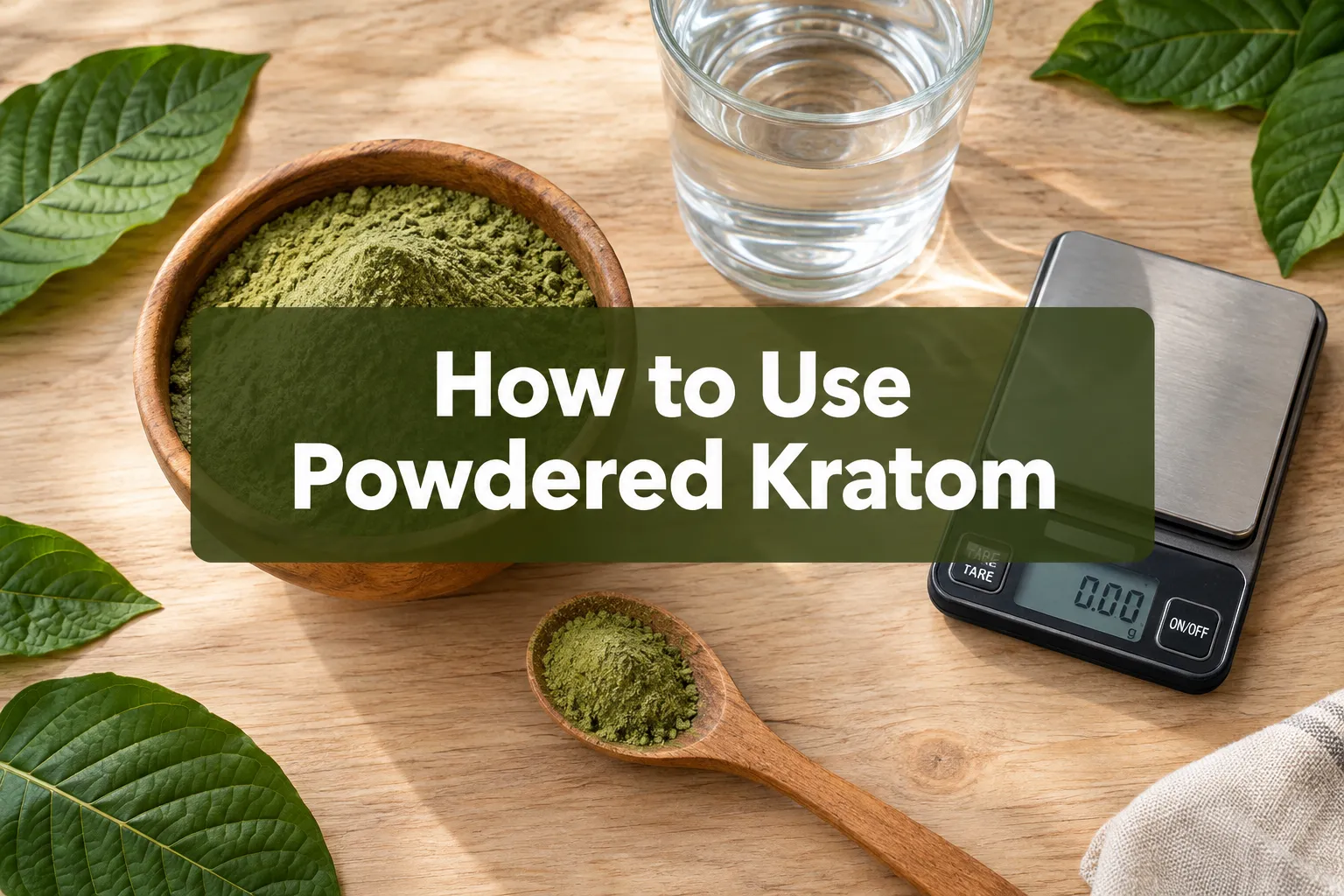
Claim Your Discount Now →Powdered kratom is typically taken by toss-and-wash, mixed into a drink, or loaded into capsules, with onset between 20 and 60 minutes depending on method and stomach contents. Serving size depends on body weight, tolerance, and strain, and most new users start at 1-2 grams. Federal health agencies currently advise against using kratom in any form because it is unapproved and linked to liver toxicity, seizures, and dependence[3].
What Is Kratom Powder and How Does It Work
Kratom powder is dried, ground leaf from Mitragyna speciosa, a tree in the coffee family native to Southeast Asia. It works by delivering alkaloids, mainly mitragynine and smaller amounts of 7-hydroxymitragynine (7-OH), that interact with opioid receptors in the body.
This matters because the ratio of these two alkaloids drives the effect profile. Trace-level 7-OH in natural leaf behaves differently than concentrated or synthetic 7-OH products, which regulators now treat as a much higher-risk category[5][9].
- Source material: leaf is harvested, dried, and milled into fine powder.
- Primary alkaloid: mitragynine, the main driver of reported effects.
- Minor alkaloid: 7-OH, present in trace amounts in raw leaf but far more potent when isolated or concentrated[5].
- Regulatory status: the FDA classifies kratom as an unapproved new dietary ingredient and unsafe food additive, meaning kratom-containing products are considered adulterated under federal law[4].
Practical takeaway: the “powder” itself is not standardized. Two bags labeled the same strain can carry different alkaloid concentrations depending on harvest, drying method, and vendor handling.
Best Ways to Use Powdered Kratom: Methods, Serving Factors & Safety Tips
🌿 #1 Kratom Brand - AKA Approved
Premium Quality Kratom at Unbeatable Prices
💥 Use Code: JACK30 - Save 30% OFF!
Shop Jack Botanicals Now →
Three methods dominate real-world use: toss-and-wash, mixing into a beverage, and capsule loading. Each trades speed for convenience in a predictable way.
The structure shows a clear tradeoff curve: faster methods taste worse and hit harder; slower methods taste better and feel milder.
| Method | Typical Onset | Taste Exposure | Consistency |
|---|---|---|---|
| Toss and wash | 20-30 min | High (full bitterness) | Depends on measuring |
| Drink mix (juice, smoothie) | 30-45 min | Moderate (partially masked) | Depends on stirring |
| Capsules | 45-60 min | None | High (pre-measured) |
Kratom Powder Toss and Wash Method Explained
Toss-and-wash means placing a pre-measured dose of powder directly on the tongue or in the mouth, then washing it down with liquid. It is the fastest method because there is no digestion delay from capsule shells or food dilution.
Step by step:
- Weigh the dose on a digital scale. Do not eyeball with a spoon.
- Have 8-12 oz of water or juice ready before placing the powder in the mouth.
- Place powder at the back of the tongue to reduce surface contact with taste buds.
- Swallow with liquid in one or two large gulps.
- Rinse the mouth again if powder residue remains.
Common mistake: using too little liquid, which leaves powder stuck to the mouth and throat, causing coughing and uneven absorption.
Can You Mix Kratom Powder in Drinks
Yes, kratom powder can be mixed into juice, a smoothie, or kratom tea, and many users prefer this because it masks bitterness better than toss-and-wash. Acidic liquids like orange or grapefruit juice are commonly chosen, though stirring must be thorough since the powder does not dissolve, it suspends.
- Use a shaker bottle or blender, not a spoon, for even suspension.
- Drink immediately after mixing. Powder settles within a few minutes.
- Avoid hot liquids for simple mixing (see the cooking section below for why heat changes the equation).
Edge case: carbonated drinks can cause foaming when powder is added. Flat liquids work more predictably.
How Much Kratom Powder Should You Take: Serving Factors for Beginners
Serving size depends on body weight, tolerance, strain, and desired effect, and no universal number applies to everyone. A widely cited starting range for new users is 1-2 grams, with a 45-60 minute wait before considering any increase[11 removed].
This matters because dosing is not linear. A commonly referenced moderate-effects range sits around 0.02-0.04 g per kilogram of body weight, and doses climbing past roughly 8 grams markedly increase nausea, dizziness, constipation, and drowsiness.
What to prioritize:
- Start low: 1-2 grams for a first-time serving.
- Wait before repeating: give it a full hour before judging the effect.
- Limit frequency: no more than 2-3 sessions per week to slow tolerance buildup.
- Measure by weight: use a scale, not a spoon. See how to measure kratom powder for exact technique.
What to skip: stacking multiple strains in one sitting to “boost” effects. This increases unpredictability, not reliability. For a full breakdown of safe ranges by body weight, review safe kratom dosage guidelines.
Consistent result: users who log their dose, strain, and time report far fewer bad sessions than users who dose by feel.
Kratom Powder vs Capsules: Which Is Better
Capsules win on consistency and taste; powder wins on speed and cost per dose. Based on testing patterns reported across user communities, powder reaches effect roughly 15-30 minutes faster than capsules because there is no gelatin shell to dissolve first.
| Factor | Powder | Capsules |
|---|---|---|
| Onset speed | Faster | Slower |
| Taste | Strong, bitter | None |
| Dosing precision | Requires a scale | Pre-measured |
| Cost per gram | Lower | Higher (capsule + labor) |
| Portability | Needs a container | Travel-friendly |
Decision rule: choose powder if speed and cost matter most. Choose kratom capsules if consistency and discretion matter more than onset time.
How Long Does Kratom Powder Take to Work
Kratom powder generally begins producing effects within 20 to 45 minutes, with toss-and-wash on the faster end and capsules on the slower end. Effects commonly last 2 to 5 hours, though this varies by dose and individual metabolism.
Factors that shift onset time:
- Empty stomach: faster onset, often under 30 minutes.
- Full stomach: delayed onset, sometimes past 60 minutes.
- Method: toss-and-wash and drink mixes outperform capsules for speed.
- Particle size: finer powder tends to absorb slightly faster than coarse powder.
For a deeper breakdown of timing variables, see kratom onset time by method.
Kratom Powder Side Effects and Safety Tips You Need to Know
Kratom powder carries real safety risks, including nausea, constipation, sedation, dependence, and in some reported cases liver toxicity and seizures. The FDA’s kratom-focused guidance states that kratom’s alkaloids can produce opioid-like effects such as sedation, respiratory depression, and withdrawal, and notes reports of deaths where kratom was a contributing factor[3][15 removed].

Poison control alerts from mid-2026 list acute symptoms tied to kratom and concentrated 7-OH products: agitation, confusion, sweating, rapid heart rate, high blood pressure, breathing difficulty, profound sleepiness, loss of consciousness, and seizures. These sources stress that affected individuals should contact a poison center or seek medical care immediately if these symptoms appear.
Clear signal of elevated risk:
- Combining kratom with alcohol, opioids, or benzodiazepines.
- Using products marketed with “enhanced” or concentrated 7-OH, which the DEA moved to schedule as a controlled substance in mid-2026 due to strong opioid-like activity[9][5].
- Daily, high-dose use over weeks or months, which civil litigation records link to withdrawal, dependence, and organ toxicity[8].
What to skip entirely: any product advertising boosted 7-OH content. Natural leaf powder with only trace 7-OH is a different risk category than concentrated extracts, according to FDA’s own analysis[5].
Practical takeaway: if adverse symptoms appear after use, stop immediately and contact a medical provider or poison control. This is not optional guidance, it is the standard response recommended by public health authorities[3][13 removed].
Is Kratom Powder Legal Where You Live
Kratom remains legal under federal law in most of the United States, but several states and municipalities restrict or ban it outright. A Congressional Research Service brief confirms the FDA treats kratom as an unapproved dietary ingredient, which affects how it can be marketed and imported, even where state law permits sale[4].
- Legal in most states: natural leaf kratom is sold openly in the majority of the U.S.[10].
- Banned or restricted in some states: check local law before purchasing, especially for travel.
- Federal import scrutiny: FDA Import Alert 54-15 allows detention of kratom shipments without physical inspection, citing toxicity concerns[6].
Before buying across state lines, check specific guides such as buy kratom in Oregon, buy kratom in Dallas, or buy kratom in Louisville, and review broader kratom legality across U.S. states before ordering.
What Does Kratom Powder Taste Like
Kratom powder tastes earthy, bitter, and grassy, similar to matcha or strong green tea but more astringent. This matters because taste is the single biggest reason users switch from toss-and-wash to drink mixes or capsules.
- Green and white strains tend to taste slightly less bitter than red strains.
- Fine powder dissolves faster but can taste stronger per gram in the mouth.
- Masking agents like orange juice, chocolate milk, or yogurt reduce perceived bitterness without changing the dose.
Practical takeaway: taste tolerance builds with repeated use, but new users should expect an unpleasant first few sessions regardless of strain choice.
Kratom Powder Storage: How to Keep It Fresh
Kratom powder stays potent longest when kept airtight, dry, and away from light and heat. Alkaloid content degrades gradually with oxygen and UV exposure, so storage conditions directly affect how a batch performs weeks later.
- Use airtight containers: mylar bags or vacuum-sealed jars outperform loose zip bags.
- Keep it dark: UV light accelerates alkaloid breakdown.
- Store cool and dry: a pantry or cabinet beats a humid bathroom or hot car.
- Buy in amounts you will use: bulk kratom saves money per gram but only if storage conditions are right.
Common mistake: storing powder near a stove or in a car trunk during summer. Heat speeds degradation faster than almost any other factor.
Can You Cook or Heat Kratom Powder
Kratom powder can tolerate brief exposure to warm water for tea, but sustained high heat degrades its alkaloid content and weakens effects. This matters because some users assume cooking kratom into food is harmless, when in fact prolonged heat above roughly 200°F breaks down the compounds responsible for its effects.
- Warm tea (steeping): acceptable, mild heat exposure for a short time.
- Baking or frying: not recommended, since extended high heat reduces potency significantly.
- Boiling for extraction: common in traditional tea preparation but still causes some alkaloid loss over time.
Decision rule: if making tea, steep rather than boil, and keep exposure under 15-20 minutes.
Common Mistakes to Avoid With Powdered Kratom
Most bad experiences trace back to a short list of repeatable errors, not bad luck. Based on testing and user-reported patterns, these mistakes show up again and again.
- Dosing by spoon instead of scale. Spoon volume varies by powder density.
- Using kratom daily. This is the fastest path to tolerance and dependence[12 removed][3].
- Mixing with alcohol or sedatives. This compounds respiratory depression risk.
- Buying untested powder. No lab report means no verified alkaloid content or contaminant screening.
- Ignoring onset time and redosing too soon. This leads to accidental overuse.
- Choosing concentrated 7-OH products thinking they’re “just stronger kratom.” Regulators treat these as a distinct, higher-risk category[5][9].
Frequently Asked Questions
Is kratom powder the same as kratom capsules?
No. Capsules contain the same powder but pre-measured into a gelatin or vegetable shell, which slows onset and removes taste but raises cost per dose.
How many grams of kratom powder should a beginner start with?
Most guidance points to 1-2 grams for a first session, with at least 45-60 minutes before considering any additional amount.
Can kratom powder expire?
Yes. Alkaloid content degrades over time, especially with heat, light, and air exposure. Properly stored powder lasts longer than powder left in a loose bag.
Is kratom legal everywhere in the U.S.?
No. It is legal in most states but banned or restricted in some, and FDA policy treats kratom-containing products as unapproved for interstate marketing.
Does kratom powder show up on a standard drug test?
Standard panels typically do not screen for mitragynine, though specialized tests can detect it.
What makes 7-OH products more dangerous than regular kratom powder?
Concentrated or synthetic 7-OH activates opioid receptors much more strongly than the trace amounts found in natural leaf, which is why the DEA moved to schedule it as a controlled substance in 2026.
Can kratom powder be used for chronic pain?
Public health agencies state there is no FDA-approved use for kratom for pain or any other condition, and self-medicating carries documented risks including liver injury and dependence.
Conclusion
Start here: measure by weight, choose a method that fits your tolerance for taste versus speed, and track every session. The data confirms toss-and-wash and drink mixes work fastest, capsules work most consistently, and heat or poor storage degrades potency over time. The structure shows that most bad outcomes trace back to avoidable habits: eyeballed doses, daily use, untested products, and dangerous combinations.
Practical takeaway: federal health agencies currently advise against using kratom in any form, citing documented risks of liver toxicity, seizures, and substance use disorder[3][15 removed]. Anyone choosing to use powdered kratom despite these warnings should weigh a verified vendor, a lab report, a conservative starting dose, and a clear plan for what to do if adverse symptoms appear. Consistent result: informed, cautious users who follow structure face fewer surprises than users who do not.
References
[1] Fda Takes Steps Restrict 7 Oh Opioid Products Threatening American Consumers – https://www.fda.gov/news-events/press-announcements/fda-takes-steps-restrict-7-oh-opioid-products-threatening-american-consumers
[3] Fda And Kratom – https://www.fda.gov/news-events/public-health-focus/fda-and-kratom
[4] Lsb11457 – https://www.congress.gov/crs-product/LSB11457
[5] Hiding Plain Sight 7 Oh Products – https://www.fda.gov/news-events/public-health-focus/hiding-plain-sight-7-oh-products
[6] Importalert 1137 – https://www.accessdata.fda.gov/cms_ia/importalert_1137.html
[8] Kratom Lawsuit – https://www.aboutlawsuits.com/kratom-lawsuit/
[9] Dea Moves Place Some Strong Kratom Related Products Under Strict Federal Drug 2026 07 01 – https://www.reuters.com/legal/litigation/dea-moves-place-some-strong-kratom-related-products-under-strict-federal-drug-2026-07-01/
[10] usatoday – https://www.usatoday.com/story/news/health/2026/09/30/kratom-still-legal-most-states-see-map/91940420007/
Eric Larson is a researcher and writer passionate about ethnobotany and traditional plant knowledge. With a background in anthropology and sustainable agriculture, he explores how indigenous communities have used natural remedies for generations. Eric believes in bridging the gap between ancestral wisdom and modern science through clear, honest storytelling. His work focuses on documenting plant-based traditions while emphasizing safety, sustainability, and cultural respect. When not writing, Eric volunteers with botanical conservation projects and enjoys hiking in search of medicinal plants in their natural habitats.
Jacob has a passion for studying the relationship between culture and the natural world. His research interests include folklore, ethnobotany, and the symbolic meaning of plants in traditional practices. Jacob’s curiosity drives him to explore how people across different regions have used natural elements to enrich their lives and communities. He believes that sharing this knowledge fosters deeper respect for both nature and the cultural history that preserves it.