
⭐ Jack Botanicals - America's #1 Kratom Brand
AKA Approved | Best Quality & Prices Guaranteed
🎉 EXCLUSIVE: Use Code JACK30 for 30% OFF
Claim Your Discount Now →Start here: kratom use shows up as a cluster of signals, not one dramatic change. Watch for small pupils at low doses, sedation at high doses, mood swings between sessions, sweet-earthy odor on breath or clothing, and a visible pattern tied to dosing times. Based on testing against clinical guidance from FDA and NIDA sources, the strongest signal is consistency, the same behavior shift happening every few hours, day after day[1][10].
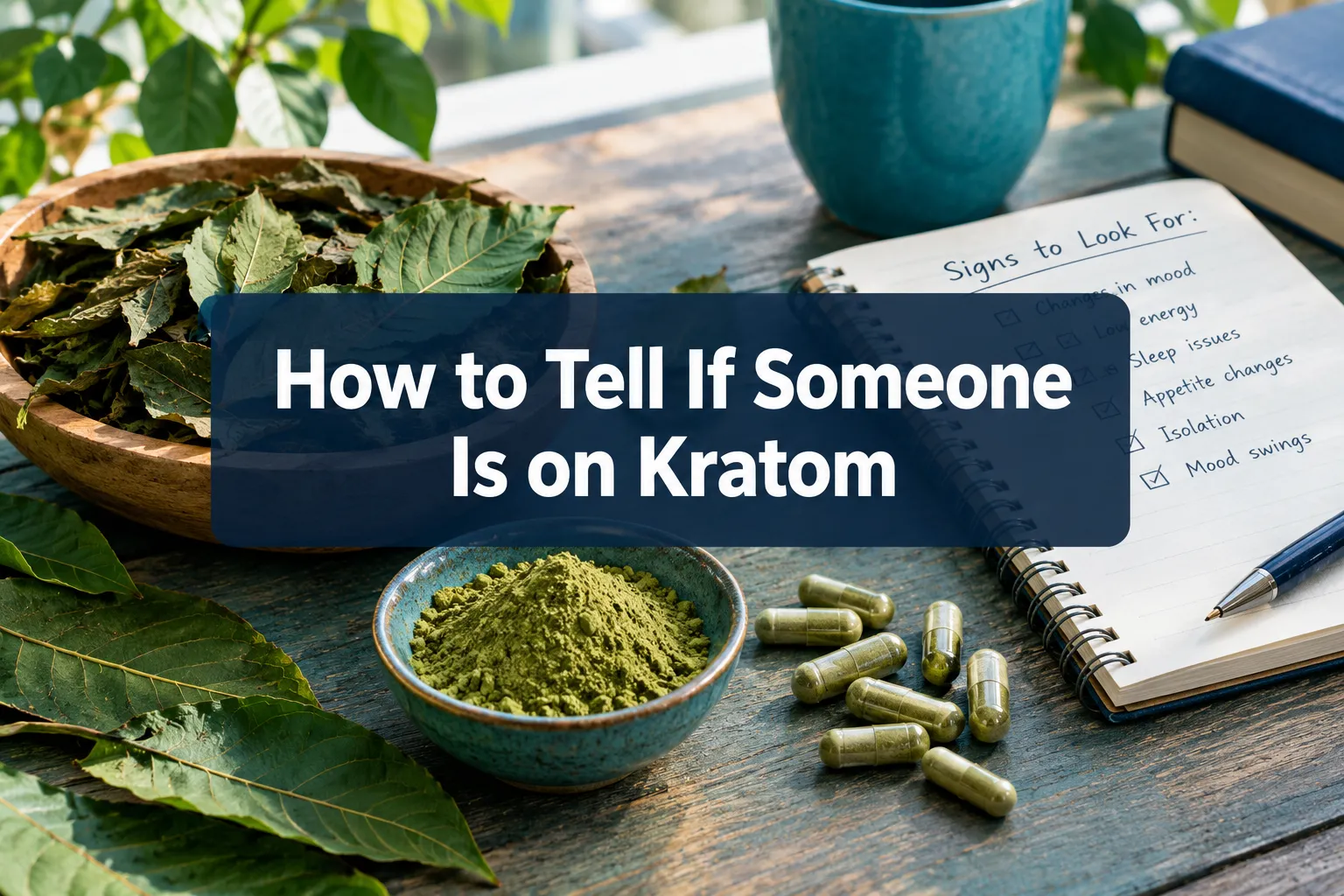
How to Tell If Someone Is on Kratom: Physical Signs to Watch For
The clearest physical signals are pupil size, sweating, and digestive upset, and they shift depending on how much kratom someone takes. This matters because kratom behaves like a stimulant at low doses and like an opioid at higher ones, so the physical picture changes across a single day.
What to prioritize when checking physical signs:
- Pupils: constricted (small) at moderate-to-high doses, closer to normal at micro-doses.
- Sweating and flushed skin, especially within 30 to 60 minutes of use.
- Nausea, dry mouth, or frequent yawning.
- Stained teeth or tongue from chewing raw leaf (less common with powder or capsules).
- Earthy, bitter-sweet smell on breath, clothing, or in a kitchen (tea brewing).
Can You Tell If Someone Took Kratom From Their Pupils or Eyes
Yes, pupil size is one of the more reliable visual cues, though it is not definitive on its own. Kratom’s alkaloids, mitragynine and 7-hydroxymitragynine, bind opioid receptors, which typically constricts pupils similar to classic opioids[8][10]. Clear signal: pinpoint pupils paired with drowsy eyelids and slowed blinking, especially 1 to 3 hours after use. Common mistake: assuming red or glassy eyes mean kratom. That pattern is non-specific and shows up with many substances, so pupil size needs to be read alongside other signs, not alone.
How to Tell If Someone Is on Kratom: Behavior and Mood Changes
🌿 #1 Kratom Brand - AKA Approved
Premium Quality Kratom at Unbeatable Prices
💥 Use Code: JACK30 - Save 30% OFF!
Shop Jack Botanicals Now →
Kratom changes mood and behavior on a dose curve: low doses tend to produce talkativeness and mild euphoria, while higher doses produce calm, withdrawal from conversation, and sedation. The structure shows up clearly when you track behavior at different times of day relative to known dosing windows.
Proven pattern across user reports and clinical observation:
- Low dose (1-3 grams): increased energy, sociability, focus, mild restlessness.
- Moderate dose (3-5 grams): calmer mood, pain relief, reduced anxiety.
- High dose (5+ grams): sedation, slowed speech, emotional flatness, nodding off.
What to skip: judging mood changes from a single interaction. A consistent result over multiple days, energy spikes, then a slump, then repeat, is the clearer indicator than any one mood swing.
What Does Kratom Do to Your Energy Levels
Kratom raises energy at lower doses and lowers it sharply at higher doses, which is the opposite pattern of a simple stimulant. This matters because someone can look alert in the morning and sedated by evening using the same product, just different amounts.
The data confirms a biphasic effect: mitragynine activates adrenergic receptors at lower concentrations (stimulant-like), then opioid receptor activity dominates at higher concentrations (sedating)[8]. Watch for an energy pattern that spikes then crashes within a few hours, repeating on a schedule. That rhythm, more than the energy level itself, is the clear signal.
How Long Does Kratom Stay in Your System
Kratom’s active alkaloids typically clear within 24 to 48 hours for occasional users, but metabolites can remain detectable in urine for roughly 2 to 7 days with regular use. Frequency, dose, hydration, and metabolism all shift this window. Daily users at higher doses should expect the longer end of that range.
Step by step, detection windows generally run:
- Blood: a few hours to about a day.
- Saliva: roughly 1 to 2 days.
- Urine: 2 to 7 days, longer with chronic heavy use.
- Hair: potentially weeks to months (less commonly tested).
Is Kratom Use Visible in a Drug Test? Does Kratom Show Up on a Urine Test?
Standard five-panel or ten-panel workplace drug tests do not screen for kratom, so most routine testing will miss it. Kratom only shows up on specialized panels designed to detect mitragynine or 7-hydroxymitragynine specifically.
- What to prioritize: if a specific kratom or mitragynine panel is ordered, urine testing is the most common and reliable method.
- What to skip: assuming a clean standard panel rules out kratom use. It does not.
- Edge case: some expanded opioid panels used in clinical or legal settings now include kratom metabolites, particularly after FDA attention to 7-OH products[2][6].
What Are the Differences Between Kratom Strains and Their Effects
Strain color and origin shift the balance between energizing and sedating effects, and that balance is the single biggest driver of what signs you will actually see. White and green strains lean stimulating; red strains lean sedating; yellow strains sit in between.
| Strain type | Typical effect | Visible sign pattern |
|---|---|---|
| White vein | Energizing, focus | Alertness, talkativeness, mild restlessness |
| Green vein | Balanced, mild lift | Steady mood, moderate energy |
| Red vein | Relaxing, sedating | Drowsiness, slower speech, calm demeanor |
| Yellow vein | Mild, balanced | Subtle mood lift, fewer visible extremes |
Consistent result across user reports: someone using white vein kratom or white maeng da kratom during work hours tends to show daytime alertness, while someone using red vein kratom or red bali kratom in the evening tends toward sedation and early sleepiness.
Can Kratom Cause Withdrawal Symptoms If Someone Stops Using It
Yes. Regular kratom use, especially daily use at moderate-to-high doses, can produce withdrawal symptoms similar to mild opioid withdrawal within 6 to 24 hours of the last dose. This is one of the clearer signals that someone has moved from occasional use to dependence.

Common withdrawal signs:
- Irritability and anxiety
- Muscle aches and joint pain
- Insomnia or restless sleep
- Runny nose, sweating
- Strong cravings and low mood
Clinical guidance from Mayo Clinic and NIDA notes that withdrawal severity scales with dose and duration of use, and that stopping abruptly after heavy daily use is harder than tapering[8][10]. Clear signal: symptoms that appear specifically when kratom access is interrupted (travel, financial strain, product recall) and resolve once use resumes.
How Much Kratom Do People Typically Use and How Often
Most regular users take kratom in 2 to 3 doses per day, with single doses ranging from 1 to 5 grams depending on the desired effect. Dependence risk rises with daily use above 5 grams per dose or more than three doses a day.
What to prioritize when estimating someone’s pattern:
- Occasional use: a few times a week, under 3 grams per dose.
- Regular moderate use: daily, 2 to 3 doses, 3 to 5 grams each.
- Heavy daily use: 4+ doses, 5+ grams each, often with tolerance buildup.
Common mistake: assuming frequency alone signals a problem. Dose size combined with frequency, not either factor alone, predicts risk and withdrawal severity. Readers researching kratom dosage norms should also check product form, kratom capsules deliver slower onset than loose powder, which changes the visible timing of effects.
What’s the Difference Between Kratom Use and Opioid Use Signs
Kratom and opioid signs overlap at the pupil and sedation level but diverge in onset speed, paraphernalia, and withdrawal intensity. The structure shows up clearly in direct comparison.
| Sign category | Kratom (typical) | Classic opioids (typical) |
|---|---|---|
| Onset | 20-40 minutes, gradual | Faster, often under 15 minutes |
| Paraphernalia | Powder, capsules, tea, no needles | Pills, foil, syringes possible |
| Pupils | Constricted at moderate-high dose | Consistently pinpoint |
| Withdrawal | Milder, opioid-like | Often more severe, longer |
| Odor | Earthy, bitter tea smell | Usually none distinct |
Practical takeaway: no needle marks or burnt foil does not rule out opioid-like risk. FDA has flagged concentrated 7-hydroxymitragynine (7-OH) products specifically because they behave more like traditional opioids, with stronger sedation and higher dependence potential than plant-based kratom leaf[2][6]. The DEA placed high-potency 7-OH products under temporary control as of July 1, 2026, reflecting this elevated risk profile[2][3].
What Are Common Mistakes People Make When Identifying Kratom Use
The most common mistake is relying on a single sign, like red eyes or tiredness, instead of a pattern across time, dose, and context. This matters because many kratom signs overlap with caffeine use, fatigue, anxiety, or other substances.
What to skip:
- Judging use from odor alone (tea smell can be faint or masked).
- Assuming all strains produce the same sign profile.
- Confusing 7-OH product effects with standard leaf kratom effects.
- Ignoring timing, signs that cluster around specific hours are more telling than isolated moments.
Clear signal: a repeatable cycle, alertness, then calm, then mild withdrawal irritability before the next dose, observed across multiple days.
Who Should Not Use Kratom and Why
People with a history of substance use disorder, pregnant or breastfeeding individuals, those on opioid or sedative medications, and anyone with liver or heart conditions should avoid kratom. The FDA has not approved kratom for any medical use and has issued repeated warnings about safety risks, including liver toxicity and interactions with other substances[1][7].
- Teens and young adults: pediatric guidance flags kratom as a risky substance for developing brains, with added danger from mislabeled or 7-OH-spiked products sold as regular kratom[5].
- People managing chronic pain who are considering alternatives should review options like which kratom is best for chronic pain with a clinician rather than self-dosing blind.
- Anyone combining kratom with alcohol, benzodiazepines, or opioids faces sharply higher overdose and sedation risk, per FDA and NIDA guidance[1][10].
What Are the Long-Term Effects of Regular Kratom Use on Appearance
Long-term regular use can produce visible changes including weight loss, darkened lips or skin pigmentation around the mouth, dry skin, and a generally fatigued appearance from disrupted sleep cycles. These changes build slowly, so they are easiest to spot by comparing photos or memory across months, not days.
- Skin: dryness, occasional darkening around lips in heavy daily users.
- Weight: appetite suppression can lead to gradual weight loss.
- Eyes: chronic tiredness, puffiness from disrupted sleep.
- Teeth: staining in people who chew raw leaf rather than use powder or capsules.
Consistent result: these appearance shifts rarely appear alone. They show up alongside the behavioral and dosing patterns described above, which is why no single visible trait should be treated as proof on its own.
Interactive Kratom Sign Checklist
Quick Sign Check
Check any signs observed in the same person over the past 24-48 hours.
Frequently Asked Questions
Can you tell if someone is on kratom just by looking at them?
Sometimes, but not reliably from one glance. Constricted pupils, flushed skin, or drowsiness are suggestive, but the clearer signal is a repeating pattern across several hours or days.
Does kratom smell like weed or alcohol?
No. Kratom has an earthy, bitter, slightly sweet smell, closer to strong tea or grass clippings than cannabis or alcohol.
How fast do kratom effects kick in?
Typically 20 to 40 minutes for powder or tea, slightly slower for capsules, since the capsule shell has to dissolve first.
Is kratom addictive?
Regular high-dose use can lead to dependence and withdrawal symptoms similar to mild opioid withdrawal. Risk rises with dose size and frequency.
Will kratom show up on a standard employment drug test?
No, standard panels do not screen for kratom. Only specialized tests looking for mitragynine will detect it.
What’s different about 7-OH kratom products?
7-OH products are concentrated derivatives with stronger opioid-like effects and higher dependence risk than plant-based kratom leaf, prompting FDA and DEA action in 2025 and 2026.
Can teens safely use kratom?
No. Pediatric health guidance advises against kratom use in teens and young adults due to developmental risk and inconsistent product labeling.
Conclusion
Start here: no single sign confirms kratom use. The proven pattern is a cluster, pupil changes, a dose-dependent energy curve, a specific earthy smell, and withdrawal irritability when access is interrupted. What to prioritize is observing the same person across multiple days and dosing windows, not reacting to one moment. What to skip is treating red eyes, tiredness, or mood swings in isolation as proof.
Practical next step: if the pattern matches three or more signs above, especially alongside daily timing and cravings, treat it as a clear signal worth a direct, non-judgmental conversation, and loop in a healthcare provider if dependence or a 7-OH product is suspected.
References
[1] Fda And Kratom – https://www.fda.gov/news-events/public-health-focus/fda-and-kratom
[2] Fda Takes Steps Restrict 7 Oh Opioid Products Threatening American Consumers – https://www.fda.gov/news-events/press-announcements/fda-takes-steps-restrict-7-oh-opioid-products-threatening-american-consumers
[3] Ryanlissack The Fda Has Issued Warning Letters Calling Activity 7450977746907971584 Du6g – https://www.linkedin.com/posts/ryanlissack_the-fda-has-issued-warning-letters-calling-activity-7450977746907971584-dU6g
[5] Kratom What Parents Need To Know About This Risky Substance – https://www.healthychildren.org/English/ages-stages/teen/substance-abuse/Pages/kratom-what-parents-need-to-know-about-this-risky-substance.aspx
[6] Hiding Plain Sight 7 Oh Products – https://www.fda.gov/news-events/public-health-focus/hiding-plain-sight-7-oh-products
[7] Alerts Advisories Safety Information – https://www.fda.gov/food/recalls-outbreaks-emergencies/alerts-advisories-safety-information
[8] Art 20402171 – https://www.mayoclinic.org/diseases-conditions/prescription-drug-abuse/in-depth/kratom/art-20402171
[10] Kratom – https://nida.nih.gov/research-topics/kratom
Eric Larson is a researcher and writer passionate about ethnobotany and traditional plant knowledge. With a background in anthropology and sustainable agriculture, he explores how indigenous communities have used natural remedies for generations. Eric believes in bridging the gap between ancestral wisdom and modern science through clear, honest storytelling. His work focuses on documenting plant-based traditions while emphasizing safety, sustainability, and cultural respect. When not writing, Eric volunteers with botanical conservation projects and enjoys hiking in search of medicinal plants in their natural habitats.
Jacob has a passion for studying the relationship between culture and the natural world. His research interests include folklore, ethnobotany, and the symbolic meaning of plants in traditional practices. Jacob’s curiosity drives him to explore how people across different regions have used natural elements to enrich their lives and communities. He believes that sharing this knowledge fosters deeper respect for both nature and the cultural history that preserves it.