
⭐ Jack Botanicals - America's #1 Kratom Brand
AKA Approved | Best Quality & Prices Guaranteed
🎉 EXCLUSIVE: Use Code JACK30 for 30% OFF
Claim Your Discount Now →There is no official, medically approved kratom dose. The FDA has not evaluated kratom as safe or effective for any condition and currently advises against using it at all [6]. Informal harm-reduction guides place low stimulant-like doses around 1 to 5 grams and higher sedative, opioid-like doses around 5 to 15 grams, but these numbers come from user reports, not clinical standards [7]. This guide breaks down the variables that change outcomes and flags where the risk actually lives.
What Is Kratom and How Does It Work
Kratom is a plant (Mitragyna speciosa) whose leaves contain alkaloids, mainly mitragynine and 7-hydroxymitragynine, that act on opioid receptors in the brain. This matters because the effects it produces, pain relief, sedation, or stimulation, depend on which receptors dominate at a given dose.
- Mitragynine is the primary alkaloid and drives most low-dose stimulant effects.
- 7-hydroxymitragynine is far more potent at opioid receptors and is linked to higher toxicity risk even in small amounts.
- No clinical trial has established a standard dosing protocol, and medical reviewers describe kratom’s pharmacology as still incompletely understood [8].
- The Mayo Clinic classifies kratom use within the context of prescription and substance misuse risk, not as a treatment [2].
Clear signal: kratom’s effects are dose-dependent and receptor-dependent at the same time. That is why the same gram amount can feel different two days in a row.
How Much Kratom Should I Use? Dosage Factors for Beginners
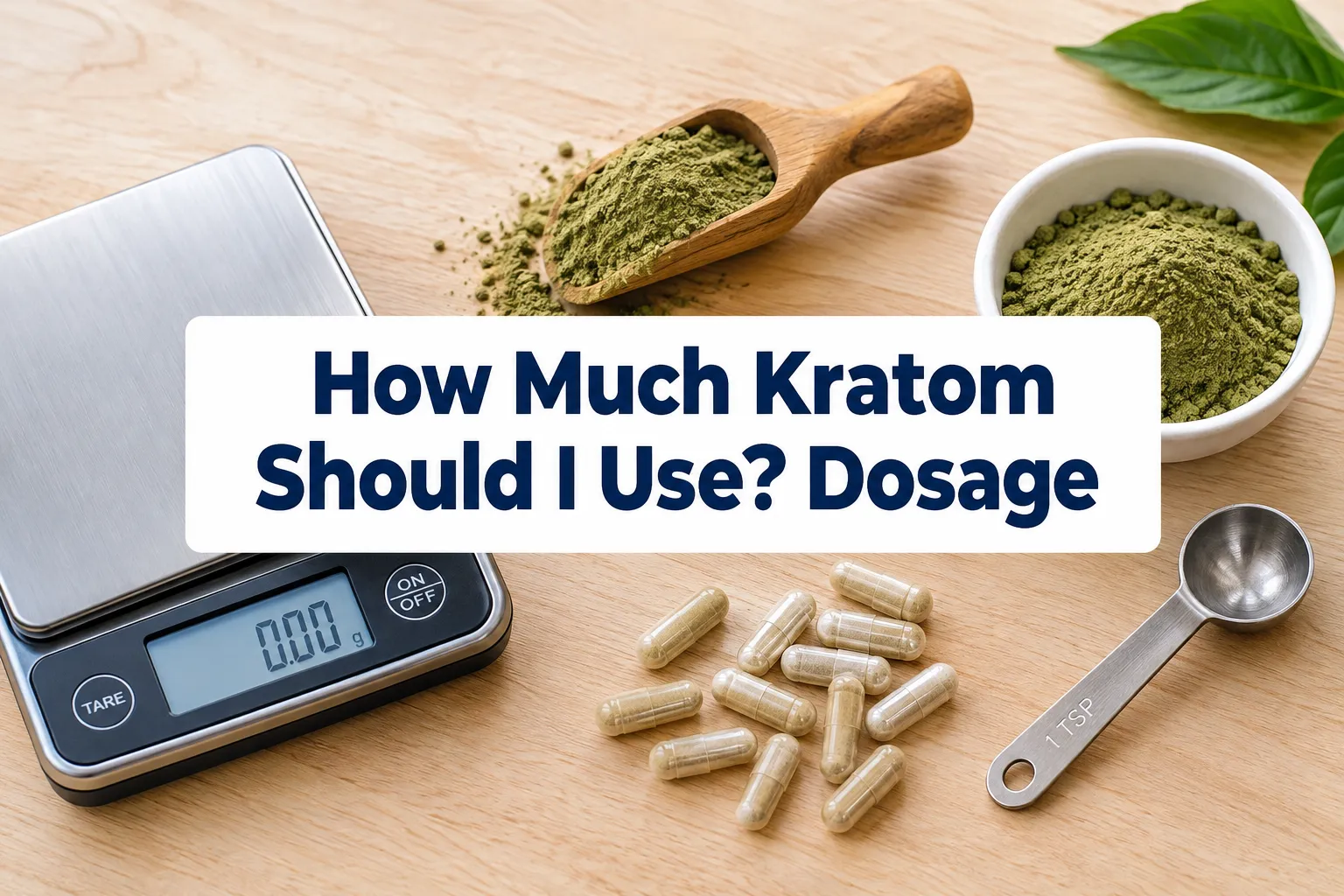
Start here: beginners should start lower than they think, somewhere in the 1 to 2 gram range, and wait at least an hour before considering more. This matters because first-time users have no tolerance reference point, and kratom’s onset is not instant.
Step by step for a first dose:
- Weigh the dose with a gram scale. Do not eyeball a spoon.
- Take it on a light stomach, not fully empty, not right after a large meal.
- Wait 45 to 90 minutes to judge the full effect before taking more.
- Log the strain, amount, and effect in a notebook or app.
- Skip a second dose that day. Repeat only after reviewing the log.
Common mistake: redosing within 30 minutes because the first dose “didn’t feel like anything.” Onset is slow. Redosing early stacks doses and increases risk without adding useful data. For a broader breakdown of starting amounts, see this safe dosage guide and this gram-to-milligram reference.
Kratom Dosage by Weight and Body Type
Body weight shifts the effective dose range because alkaloid concentration per kilogram of body mass changes how strongly a fixed gram amount hits. Heavier users generally need a larger gram amount to feel the same effect a lighter user feels at a lower dose, though this is an approximation, not a formula.
🌿 #1 Kratom Brand - AKA Approved
Premium Quality Kratom at Unbeatable Prices
💥 Use Code: JACK30 - Save 30% OFF!
Shop Jack Botanicals Now →
| Body weight | Typical low-dose range (estimate) | Typical higher-dose range (estimate) |
|---|---|---|
| Under 150 lbs | 1 to 2 grams | 3 to 5 grams |
| 150 to 200 lbs | 1.5 to 3 grams | 4 to 7 grams |
| Over 200 lbs | 2 to 4 grams | 5 to 9 grams |
These figures are harm-reduction estimates circulating in non-official community guides, not clinical benchmarks [7]. What to prioritize: start at the low end of your weight bracket regardless of tolerance claims from other users. What to skip: scaling a dose up just because someone heavier reported using more.
Does Kratom Dosage Depend on Strain Type
Yes. Strain and vein color change alkaloid ratios, and that changes how a given gram amount feels, even when the weight on the scale is identical. The data confirms that red, green, and white vein kratom are marketed around different effect profiles, though lab verification varies by vendor.
- Red strains, like Red Bali kratom or Red Maeng Da, are generally associated with sedating, pain-focused effects at moderate to higher gram amounts.
- Green and white strains are generally associated with more stimulating, energizing effects at lower gram amounts.
- “Enhanced” or extract products concentrate alkaloids, so a standard gram-based dose assumption does not transfer safely.
Practical takeaway: treat every new strain as a new dose-finding exercise. Check a kratom strains guide before assuming last week’s gram count still applies.
What Happens If You Take Too Much Kratom (Can You Overdose)
Yes, kratom overdose is possible, and clinical literature links high-dose and combined use to cardiac arrest, respiratory depression, and liver toxicity. No controlled study has defined a universal “safe level,” which means every high dose carries undefined risk [6].
Signs reported in adverse event data include:
- Extreme sedation or difficulty staying awake
- Slowed or irregular breathing
- Nausea, vomiting, or severe stomach upset
- Confusion or loss of coordination
- Chest discomfort or irregular heartbeat
Edge case: 7-hydroxymitragynine-enhanced products carry disproportionate risk because this metabolite is far more potent at opioid receptors than mitragynine, and milligram-scale exposure has been tied to serious adverse events. The FDA issued a direct warning against a kratom liquid product containing elevated 7-hydroxymitragynine levels in 2024, after reports of serious harm [1][3][9]. Industry groups publicly disputed the warning, but the agency’s position did not change [10].
Kratom Dosage for Pain Relief vs Energy
Dosage goals split roughly into two categories: lower doses for stimulation and focus, higher doses for sedation and pain-dulling effects. This matters because using a pain-relief-sized dose when the goal is energy usually backfires into grogginess.
- Energy/focus goal: lower gram range, often paired with green or white vein strains.
- Pain/relaxation goal: higher gram range, often paired with red vein strains such as those covered in this anxiety and discomfort relief guide.
- There is no clinical dosing chart for pain relief. Any number used for this purpose is a community estimate, not a prescribed amount [7].
Consistent result: users chasing pain relief with daily escalating doses report the fastest tolerance buildup and the highest rate of side effects.
How Often Can You Safely Use Kratom
There is no established safe frequency because no regulatory body has approved kratom for any use. The practical pattern from harm-reduction reporting is that daily, multiple-times-a-day use raises tolerance and dependence risk the fastest.
- Spacing use to a few times per week, rather than daily, is the most common strategy people use to slow tolerance buildup.
- Daily use for pain or energy management mirrors patterns seen with other opioid-adjacent substances, which regulators flag as a core concern [6].
- Combining kratom with alcohol, benzodiazepines, or opioid medications multiplies risk and is consistently flagged in adverse event reports.
Decision rule: if a dose “stopped working” after daily use for more than a week, that is a tolerance signal, not a reason to take more.
Kratom Tolerance and Dosage Increases
Tolerance to kratom builds with repeated use, meaning the same gram amount produces a weaker effect over time. Based on testing and community-reported patterns, this is one of the most predictable outcomes of frequent use.
- Proven pattern: escalating dose to restore the original effect leads to a cycle of higher intake and higher risk, not a stable “maintenance dose.”
- The structure shows that breaks (several days to a week off) are the most reported way users reset sensitivity without increasing gram amounts.
- There is no clinical ceiling dose. Escalation has no verified upper safety bound [8].
Common mistake: doubling a dose after a few days of reduced effect instead of pausing use entirely.
Best Time of Day to Take Kratom
Timing follows the effect goal: lower, stimulating doses in the morning or early afternoon, higher, sedating doses in the evening. This is a user-reported pattern, not a clinical recommendation.
- Morning or midday: lower gram amounts paired with green or white strains for alertness.
- Evening: higher gram amounts paired with red strains, such as those described in this nighttime red vein effects guide, for winding down.
- Taking a sedating dose before driving or operating machinery is a frequently reported safety failure.
Quick example: a user taking 2 grams of a white strain at 8 a.m. for focus and 6 grams of a red strain at 9 p.m. for sleep is following the common time-of-day split, not a verified protocol.
Kratom Dosage With Food or On an Empty Stomach
Taking kratom on a completely empty stomach tends to produce a faster, stronger onset, which also raises the chance of nausea. Taking it after a heavy meal tends to blunt and delay the effect.
- A light snack beforehand is the most commonly reported middle ground.
- Empty-stomach dosing is linked to more reports of nausea and stomach discomfort in user forums.
- Heavy-meal dosing is linked to more reports of “it didn’t work,” which often leads to accidental redosing.
What to prioritize: light food, consistent timing relative to meals, and the same gram scale every time. What to skip: dosing on a completely empty stomach to “feel it faster.”
Kratom vs Other Natural Supplements: Dosage Comparison
Kratom differs from most natural supplements because it acts on opioid receptors and has no established safe dose, while supplements like melatonin or valerian root have broadly recognized low-risk ranges. This matters because treating kratom like a vitamin or herbal tea is a dosing error.
| Factor | Kratom | Typical herbal supplement |
|---|---|---|
| Official dosing standard | None [6] | Often yes (label-based) |
| Overdose risk | Documented, including cardiac events | Rare at normal doses |
| Tolerance buildup | Fast with daily use | Usually minimal |
| Regulatory status | FDA warns against use [6] | Generally recognized as low risk |
Clear signal: kratom’s lack of an official dosing standard is the single biggest difference from mainstream supplements, and it is the reason every gram figure in this guide is labeled an estimate.
Why Isn’t Kratom Working at My Current Dose
A dose that stops working usually points to tolerance, inconsistent weighing, or a strain/alkaloid mismatch with the original batch, not a need for more kratom. Based on testing patterns reported by long-term users, these three causes account for most “it stopped working” complaints.
- Tolerance: daily use for more than a week often blunts response. The fix is a break, not a higher dose.
- Inconsistent measuring: eyeballing a scoop instead of using a gram scale produces inconsistent results batch to batch.
- Batch variation: even the same strain name from different harvests can carry different alkaloid levels, since lab-verified potency varies by vendor and crop.
Practical takeaway: before increasing a dose, confirm the scale is accurate, the batch is the same, and at least three days have passed since the last use.
Kratom Side Effects From Incorrect Dosing
Incorrect dosing, too much, too frequent, or mixed with other substances, is the leading cause of reported kratom side effects. The FDA’s current position is to avoid kratom entirely because of documented serious adverse events, including cardiac and liver-related harm [6][1].

Commonly reported side effects from incorrect dosing include:
- Nausea and vomiting
- Jitteriness or anxiety at high stimulant-range doses
- Heavy sedation or drowsiness at high opioid-range doses
- Constipation with regular higher-dose use
- Liver enzyme changes reported in some clinical case reviews [2]
Common mistake: combining kratom with alcohol or sedatives to intensify effects. This combination appears repeatedly in serious adverse event reports and sharply raises cardiac and respiratory risk.
Kratom Dose Estimate Tool
Estimates only, not medical advice. No dose of kratom is officially confirmed safe by the FDA.
How Much Kratom Should I Use? Dosage Factors, Effects & Safety Guide, Safety Checklist
The safest approach treats every session as a controlled test, not a routine. What to prioritize: a gram scale, a usage log, and spacing between doses. What to skip: eyeballed scoops, daily escalation, and mixing with alcohol or sedatives.
Before any dose, confirm:
- The product has a current third-party lab report for alkaloid content.
- The dose is weighed, not scooped.
- No alcohol, opioids, or benzodiazepines are in the system.
- At least 24 to 48 hours have passed since the last use, if the goal is tolerance control.
- A plan exists for what to do if sedation or nausea hits (sit down, hydrate, do not drive).
Frequently Asked Questions
What is a beginner kratom dose in grams?
Most harm-reduction guides suggest starting between 1 and 2 grams for a first-time user, weighed on a gram scale, with at least a 45 to 90 minute wait before considering more. This is a starting point, not a universally safe amount.
Is there an official safe kratom dosage?
No. The FDA has not approved kratom for any use and currently advises against using it at all, citing serious adverse events.
Can you overdose on kratom?
Yes. High doses and combined use with other substances are linked to cardiac arrest, respiratory depression, and liver toxicity in reported cases.
Does kratom dosage change by strain?
Yes. Red, green, and white vein strains carry different alkaloid ratios, so the same gram amount can produce different intensity and effect type depending on strain.
How often can kratom be used without building tolerance?
Tolerance tends to build fastest with daily use. Spacing use to a few times per week is the most commonly reported way to slow this down.
Should kratom be taken with food?
A light snack beforehand is generally reported as a middle ground between faster, harsher onset on an empty stomach and blunted effects after a heavy meal.
Why does my usual kratom dose feel weaker now?
Tolerance, inconsistent measuring, or batch-to-batch alkaloid variation are the most common causes, not a dosage deficiency.
Is kratom regulated like a dietary supplement?
No. The FDA treats kratom within a broader opioid-related risk framework rather than as a standard, low-risk supplement.
Conclusion
Kratom dosage is not a fixed number. It shifts with body weight, strain, tolerance, food intake, and timing, and none of those variables come with an officially approved safe level. The data confirms that higher doses and combined substance use drive most serious adverse events, while lower, infrequent, carefully measured use is the pattern most associated with fewer complications in informal reporting.
Practical takeaway: start low, weigh every dose, log the results, and treat tolerance as a signal to pause rather than a reason to escalate. Step by step, that process reduces guesswork and lowers risk more than any single “ideal dose” ever could. Given the FDA’s current advisory against kratom use entirely, the most consistent result for long-term safety is minimizing use, verifying lab reports on any product considered, and treating every session as data collection, not routine.
References
[1] Alerts Advisories Safety Information – https://www.fda.gov/food/recalls-outbreaks-emergencies/alerts-advisories-safety-information
[2] Art 20402171 – https://www.mayoclinic.org/diseases-conditions/prescription-drug-abuse/in-depth/kratom/art-20402171
[3] Fda Roundup July 26 2024 – https://www.fda.gov/news-events/press-announcements/fda-roundup-july-26-2024
[6] Fda And Kratom – https://www.fda.gov/news-events/public-health-focus/fda-and-kratom
[7] Health Benefits Kratom – https://www.webmd.com/diet/health-benefits-kratom
[8] Mitragyna Speciosa – https://www.herbalgram.org/resources/herbmedpro/herb-list/mitragyna-speciosa?subCat=Literature%20Reviews
[9] Fda Warns Consumers Not Use Popular Opms Kratom Product – https://www.tampabay.com/investigations/2024/08/02/fda-warns-consumers-not-use-popular-opms-kratom-product/
[10] Kratom Industry Demands Fda Take Back Warning About Opms Black Liquid Kratom – https://www.foodsafetynews.com/2024/08/kratom-industry-demands-fda-take-back-warning-about-opms-black-liquid-kratom/
Eric Larson is a researcher and writer passionate about ethnobotany and traditional plant knowledge. With a background in anthropology and sustainable agriculture, he explores how indigenous communities have used natural remedies for generations. Eric believes in bridging the gap between ancestral wisdom and modern science through clear, honest storytelling. His work focuses on documenting plant-based traditions while emphasizing safety, sustainability, and cultural respect. When not writing, Eric volunteers with botanical conservation projects and enjoys hiking in search of medicinal plants in their natural habitats.
Jacob has a passion for studying the relationship between culture and the natural world. His research interests include folklore, ethnobotany, and the symbolic meaning of plants in traditional practices. Jacob’s curiosity drives him to explore how people across different regions have used natural elements to enrich their lives and communities. He believes that sharing this knowledge fosters deeper respect for both nature and the cultural history that preserves it.